Why AI Overviews Are Changing the Way People Find Your Business
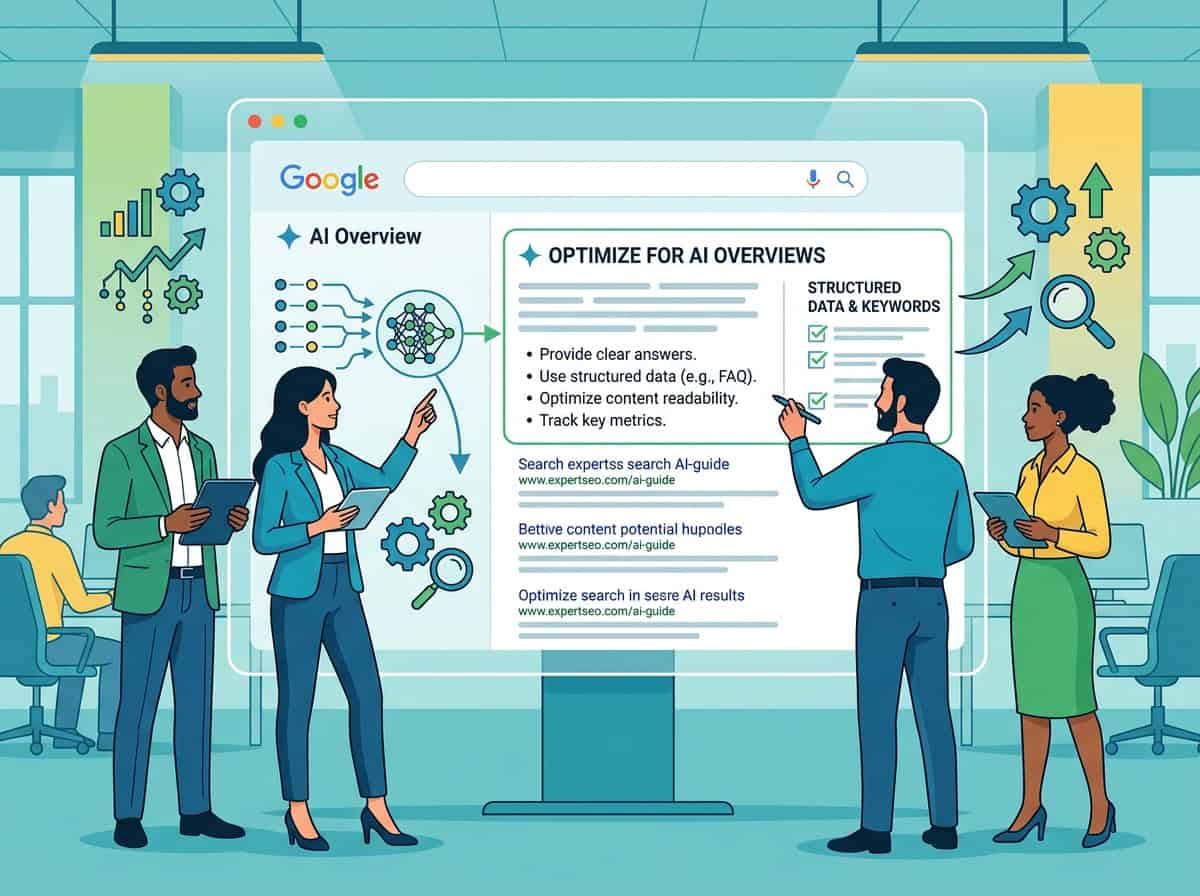
Optimizing for AI Overviews is how you get your business cited in Google’s AI-generated summaries that appear at the very top of search results — above all other organic listings.
Here’s a quick breakdown of what it takes:
- Make your site crawlable — Google’s AI can’t cite what it can’t access
- Structure content with answers first — lead every section with a direct, factual response
- Use schema markup — help Google understand what your content is about
- Build E-E-A-T signals — demonstrate real expertise and trustworthiness
- Optimize your Google Business Profile — critical for local AI Overview citations
- Earn brand mentions — third-party references matter more than backlinks
- Keep content fresh — AI engines favor recently updated pages
Google’s search results page looks very different than it did just two years ago. A new feature — called an AI Overview — now sits at the top of many search results, giving users an instant AI-generated answer before they ever see a single website link.
That’s a big deal for small business owners.
When an AI Overview is present, users click traditional search results only 8% of the time, compared to 15% when there’s no AI Overview. For informational searches, some studies suggest clicks to regular organic listings may drop by more than 50%.
But here’s the flip side: if your business gets cited inside that AI Overview, you gain massive visibility — even if the user never scrolls down.
This guide walks you through exactly how to earn that spot.
I’m Rob Dietz, a digital marketing consultant with over 18 years of experience helping businesses grow their online presence — including managing Google marketing campaigns since 2008. I’ve spent that time watching search evolve through every major shift, and learning how to optimize for AI Overviews is the most important adaptation small business owners need to make right now.

Understanding Google AI Overviews and How They Work
Google AI Overviews (formerly known during testing as the Search Generative Experience or SGE) are AI-generated responses that appear at the very top of the Search Engine Results Page (SERP). Powered by Google’s Gemini large language model, these overviews synthesize information from across the web to provide a comprehensive answer to a user’s query in seconds.
But how does the “brain” behind the screen actually decide what to show? It uses a process called query fan-out. Instead of just looking for a single keyword match, the system runs multiple related searches simultaneously to gather a “rounded” view of the topic. It then evaluates these signals using mathematical relevance.
Every word and passage on your website has a mathematical value in Google’s eyes. The AI compares your “passage vectors” (the mathematical representation of your content) against the user’s query. If your content matches the intent most closely, you get the citation.
The impact on user behavior is staggering. Pew Research Center report suggests users click traditional search result links just 8% of the time when an AI Overview is present, and only 1% of users actually click the links within the AI Overview itself. This creates a “winner-take-all” environment where being the cited authority is the only way to stay relevant.
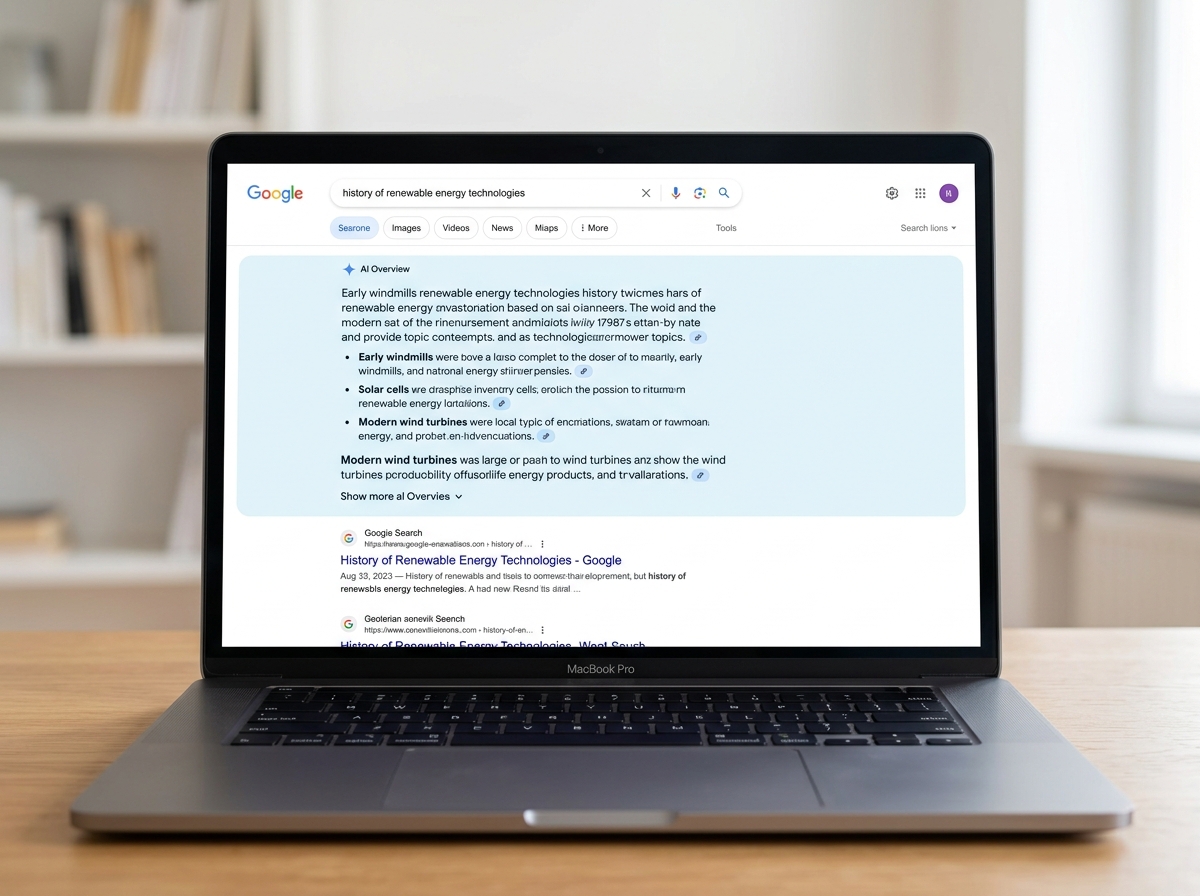
Furthermore, these AI boxes are massive. On average, an AI snapshot box is about 1764 pixels in height. On a standard laptop screen, that often means the user sees nothing but the AI answer and perhaps one or two ads before they even have to scroll. This “pushdown” effect makes traditional SEO rankings in positions 4 through 10 much less valuable than they used to be.
Core Strategies to Optimize for AI Overviews
To survive this shift, we have to move beyond traditional SEO and embrace Generative Engine Optimization (GEO). While traditional SEO focuses on keywords and backlinks to rank “blue links,” GEO focuses on becoming the trusted source that the AI uses to build its answer.
| Feature | Traditional SEO | Generative Engine Optimization (GEO) |
|---|---|---|
| Primary Goal | Rank #1 in blue links | Get cited in AI Overviews/LLMs |
| Content Focus | Keyword density & length | Factual density & “Answer-First” |
| Authority Signal | Backlinks | Brand mentions & E-E-A-T |
| User Intent | Clicks to website | Providing the definitive answer |
The foundation of your strategy should be factual density. AI models prefer content that packs a lot of information into a small space. We recommend aiming for at least one specific, verifiable data point every 150-200 words. These act as “citation hooks” that the AI can easily grab and repurpose.
Google’s official recommendation for optimizing for AI features is to continue following foundational SEO best practices. However, we’ve found that brand mentions on third-party sites (like Reddit, local news, or niche forums) are now up to three times more influential for AI visibility than traditional backlinks. If people are talking about you as an expert in Monroe, NC, Google’s AI is much more likely to trust your site as a source. For more on targeting the right audience, check out our guide on Where in the World: A Guide to Geo-Specific Keyword Targeting.
Structuring Content to Optimize for AI Overviews
The “shape” of your content matters just as much as the quality. To optimize for ai overviews, you need to use an answer-first pattern. This means the very first paragraph under any heading should be a standalone, 40-to-60-word direct answer to the question posed by that heading.
Think of these as self-contained content units. If an AI “lifted” just one paragraph from your page, would it make sense on its own? It should. We also suggest:
- Using a clear H2/H3 hierarchy that mirrors real-world user questions.
- Utilizing bulleted lists and tables; research shows tables are cited at 2.5 times the rate of standard prose.
- Targeting long-tail keywords (queries with 4+ words) which are more likely to trigger an AI Overview.
By using a “claim-evidence” structure—where you make a statement and immediately follow it with data or a quote—you make it incredibly easy for the Gemini model to parse your expertise. For a deeper dive into ranking basics, see How Do You Get Listed at the Top of Search Engines?.
Leveraging E-E-A-T and Information Gain
Google’s AI doesn’t just want the “correct” answer; it wants the best answer. This is where E-E-A-T (Experience, Expertise, Authoritativeness, and Trustworthiness) comes in. According to Google’s Search Quality Rater Guidelines, demonstrating first-hand experience is now a top-tier signal.
To stand out, you need information gain. This means providing something new that isn’t already in the “consensus” results. If every other plumber in Monroe says “we fix leaks,” and you provide a proprietary data set on “the top 5 reasons pipes burst in North Carolina winters,” you are filling an entity gap. The AI will favor your content because you are providing unique value it can’t find elsewhere.
We always tell our clients: don’t just repeat what’s already out there. Use an authoritative tone, cite your own case studies, and Stop Being Invisible with Better Online Local Search Strategies.
Technical SEO and Structured Data for AI Visibility
If Googlebot can’t read your site, Gemini can’t cite it. Crawlability is the absolute baseline. You must ensure your robots.txt file isn’t accidentally blocking AI crawlers like
Google-Extended
or
GPTBot
.
Technical health is more than just “not being blocked.” It’s about being easy to digest. What is Technical SEO and How Does It Help Your Website? It’s the framework that allows search engines to understand your site’s hierarchy and speed.
One of the most powerful things you can do is validate the structured data markup on your site. Schema markup is like a “cheat sheet” for AI. Specifically:
- FAQPage schema: This helps AI pull direct Q&A pairs.
- Service schema: This defines exactly what you do and where you do it.
- Review schema: High-star ratings in your code build immediate trust.
We also recommend using IndexNow to instantly notify search engines of content updates. Freshness is a major signal for AI; content that is even 26% fresher than the competition has a much higher chance of being cited.
Local SEO and Google Business Profile Optimization
For businesses in Monroe, NC, local AI Overviews are a game-changer. These summaries often pull directly from your Google Business Profile (GBP) and display a map with citations. This makes AI and Local SEO GBP integration vital.
Your reputation is now a ranking factor. Do Online Reviews Really Matter? Absolutely. AI Overviews analyze review sentiment. If your reviews frequently mention “fast service” or “fair pricing,” the AI will use those specific attributes to describe your business in the overview (e.g., “Dietz Group is known for high-ROI strategies and 18+ years of expertise”).
Using LocalBusiness schema and our Google Business Profile Management Services ensures that your “NAP” (Name, Address, Phone number) is consistent across the web, which reinforces your “entity” in Google’s Knowledge Graph.
How to Optimize for AI Overviews in Local Search
To dominate the local AI space, you have to lean into proximity signals. The AI is smart enough to know where the user is and which businesses are nearby. However, proximity isn’t everything. You also need to:
- Ensure your NAP is Critical for Local SEO and perfectly matched across all directory listings.
- Follow our 3 Tips to Optimize Your Google Business Profile, such as uploading high-quality photos and videos regularly.
- Get mentioned in geographic subreddits or local news. If the “Monroe” subreddit is discussing your services, Google’s AI treats that as a massive trust signal.
Measuring Success and Tracking AI Performance
You can’t manage what you don’t measure. Traditional keyword tracking isn’t enough anymore because your “rank” might be #1, but you could still be hidden behind a massive AI box. You need to track your share of voice within AI responses.
Major SEO tools have recently evolved; for instance, Semrush has started tracking site’s visibility in AI Overviews under their position tracking reports. You should be looking at:
- Citation Frequency: How often is your URL cited in the AI box?
- Referral Traffic: Is the traffic coming from AI sources converting? (AI-referred traffic often converts 3-5x better than standard organic traffic because the user is already “pre-sold” by the AI’s recommendation).
- Sentiment: How is the AI describing your brand?
Effective Online Presence Management means looking at the big picture—how your brand exists across the entire AI ecosystem.
Frequently Asked Questions about AI Overviews
What triggers an AI Overview to appear?
AI Overviews most commonly appear for informational queries and “how-to” searches. There is a very strong correlation between featured snippets and AI Overviews. If a search query requires a complex, multi-step answer or involves comparing multiple products, Google is much more likely to generate an AI summary. Conversely, they appear less often for simple navigational queries (like searching for a specific login page).
Can I opt out of having my content in AI Overviews?
Yes, but it’s a double-edged sword. You can use the
nosnippet
tag or the
noindex
directive to prevent Google from using your content in snippets or indexing the page entirely. You can also use
data-nosnippet
on specific parts of a page. However, doing this will almost certainly hurt your overall organic visibility. Most businesses are better off leaning into the technology rather than trying to hide from it.
How do AI Overviews affect organic click-through rates?
It’s a mixed bag. For simple, factual questions, AI Overviews lead to more zero-click searches because the user gets the answer without clicking. We’ve seen informational query CTRs drop by over 50%. However, for complex queries where the AI cites your business as a “top recommendation,” the traffic you do get is much higher quality. The 1764-pixel pushdown is real, but a citation at the top of that box is worth more than a #1 organic ranking used to be.
Conclusion
The era of “ten blue links” is fading, but the opportunity for businesses that adapt is greater than ever. By focusing on factual density, E-E-A-T, and technical readiness, you can ensure your business isn’t just a link on page one, but the primary answer Google gives to its users.
At Dietz Group, we specialize in navigating these complex shifts. Whether you need a Local Generative Engine Optimization Agency to help you get cited or expert management of your local search presence, we have the 18+ years of expertise to get you there. Don’t let your business become invisible in the age of AI—let’s work together to put you at the top.