Search Is No Longer Just Google — Here’s What That Means for Your Business
What is Search Everywhere Optimization is one of the most important questions any small business owner can ask right now. Here’s the short answer:
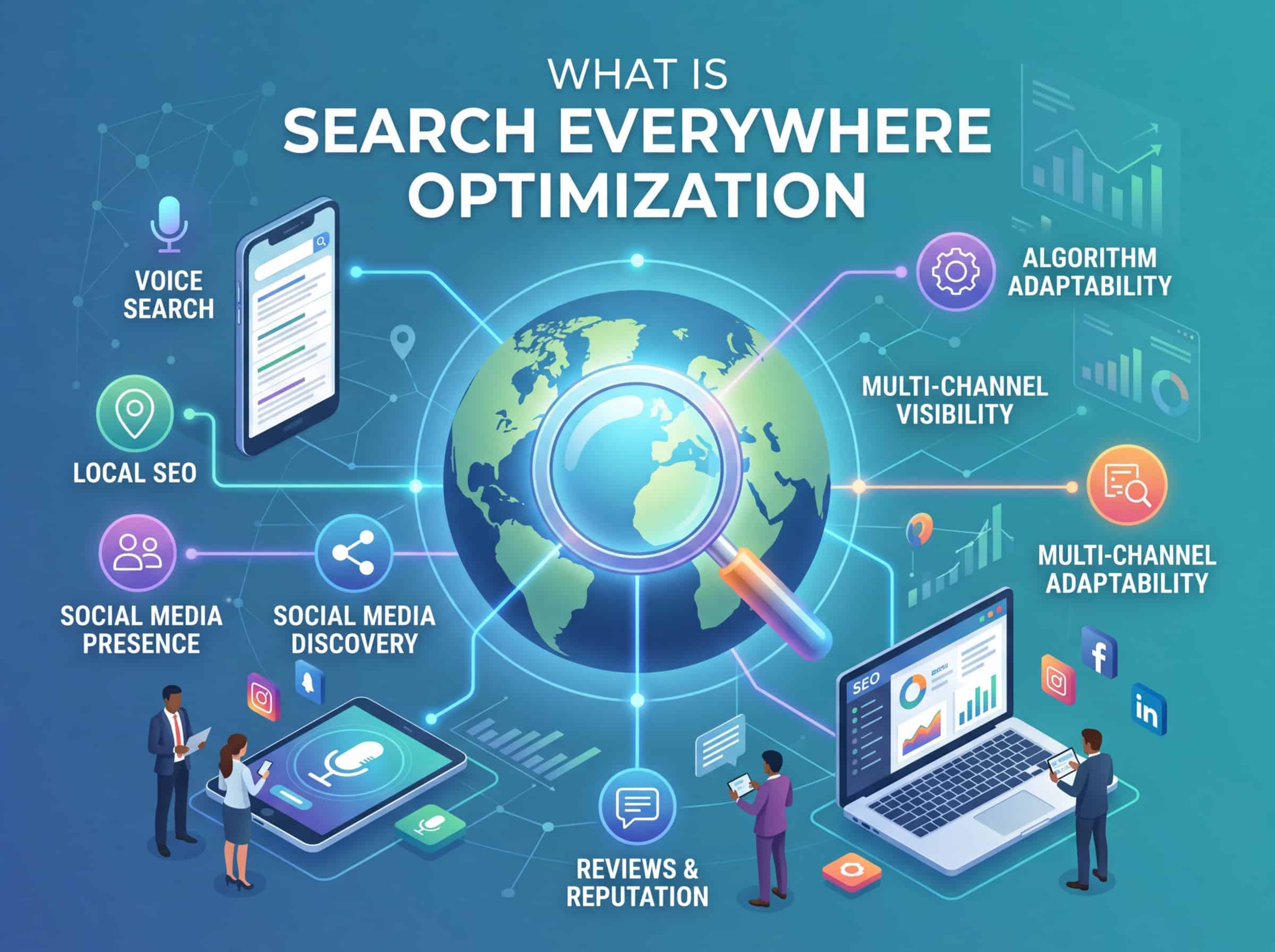
Search Everywhere Optimization (SEOx) is the practice of making your business easy to find across every platform where your customers search — not just Google. That includes YouTube, TikTok, Instagram, Amazon, ChatGPT, voice assistants, and more.
Quick breakdown:
- Traditional SEO = optimizing for Google and Bing
- Search Everywhere Optimization = optimizing for every platform where people discover products, services, and answers
Think about how you searched for something recently. Maybe you checked Google, then watched a YouTube review, then looked it up on Amazon. Your customers do the same thing — and they’re doing it across more platforms every year.
Relying on Google alone is a real business risk.
I’m Rob Dietz, a digital marketing consultant with over 18 years of experience helping small businesses grow their online presence — and understanding what is Search Everywhere Optimization has become central to everything I do for clients today. If you’ve noticed your leads slowing down despite solid Google rankings, this guide will show you exactly why that’s happening and what to do about it.

What is Search Everywhere Optimization?

At its core, What is Search Everywhere Optimization? is the strategic evolution of digital discovery. In the old days, we focused entirely on “findability” on a single search results page. Today, we focus on retrievability across a fragmented digital landscape.
When we talk about Search Everywhere Optimization, we are talking about meeting the user wherever their intent takes them. If a user wants to know how to fix a leaky faucet, they might go to YouTube. If they want to see if a specific pair of boots looks good on a real person, they head to TikTok or Instagram. If they want an immediate, synthesized answer to a complex legal question, they might ask ChatGPT.
Search Everywhere Optimization ensures that your brand’s “answers” are present on all these surfaces. It moves us away from just chasing blue links on a website and toward becoming a recognized entity that AI assistants and social algorithms trust enough to recommend.
Why Modern User Behavior Requires Search Everywhere Optimization
The way people find information has fundamentally fractured. We are no longer a “Google-first” society across every demographic. Consider these shifts in search behavior:
- Generational Shifts: Approximately 40% of Gen Z prefers searching on TikTok or Instagram over Google. For them, social media isn’t just for chatting; it’s a visual search engine.
- The Rise of Zero-Click Searches: Nearly 60% of Google searches end without a click-through. This happens because Google provides the answer directly on the result page (via AI Overviews or Featured Snippets). If you aren’t optimized to be the source of that snippet, you lose the “impression” entirely.
- Marketplace Dominance: 56% of U.S. shoppers start their product search directly on Amazon. If you only optimize your website and ignore your Amazon presence, you are missing more than half of your potential market.
- The “Reddit” Phenomenon: More than 100 people add the word “reddit” to their Google searches every single second. Users are craving human-vetted, community-driven advice over corporate blog posts.
The Evolution from Traditional SEO to SEOx
To understand What is Search Engine Optimization, you have to look at its history. It started as a quantitative game—stuffing keywords into meta tags to please a relatively simple algorithm.
The Purpose of Search Engine Optimization has always been about visibility, but the “how” has changed. We have moved from being keyword-centric (matching exact phrases) to being entity-driven.
In the SEOx era, search engines and AI models try to understand the relationship between things. They don’t just see the word “plumber”; they see a business entity with a physical location, a set of verified reviews, a library of helpful YouTube shorts, and a consistent history of answering customer questions across the web. SEOx is about building that comprehensive digital footprint so that you are “everywhere” at once.
Traditional SEO vs. Search Everywhere Optimization
While traditional SEO is the foundation, SEOx is the skyscraper built on top of it. Here is how they compare:
| Feature | Traditional SEO | Search Everywhere Optimization (SEOx) |
|---|---|---|
| Primary Goal | Rank #1 on Google/Bing | Be the top answer on any platform the user uses |
| Main Asset | Your Website | Website + Social Profiles + Marketplace Listings + AI Citations |
| Search Intent | Informational/Transactional (Text) | Visual, Conversational, Community, and Commercial |
| Success Metric | Organic Traffic / Clicks | Branded Search Volume / Omnichannel Mentions / Leads |
| Algorithm Focus | Backlinks & Technical SEO | E-E-A-T, Structured Data, & Platform Engagement |
Understanding Local SEO vs National SEO is still vital, but SEOx takes those local signals and broadcasts them across more “surfaces” like Apple Maps, voice assistants, and local Facebook groups. If you want to know How Do You Get Listed at the Top of Search Engines, the answer is no longer just “fix your title tags”—it’s “build a cohesive brand presence across the entire web.”
Is Traditional SEO Still Relevant?
Absolutely. Don’t let anyone tell you that your website doesn’t matter anymore. Traditional SEO remains the foundational layer of any Search Everywhere strategy. Your website is the “canonical source” of truth for your business.
We still need to focus on:
- Technical SEO: If your site is slow or broken, AI crawlers can’t read it to summarize your info for ChatGPT.
- Authority Building: High-quality Local SEO Services for Small Businesses still rely on building local relevance through your own domain.
- Site Speed and UX: These are “table stakes.” Without a solid website, you have nowhere to send the traffic you capture from other platforms.
The Role of AI and Generative Search
Generative Engine Optimization (GEO) is a massive part of the “Search Everywhere” world. When someone asks an AI tool like Perplexity or Gemini a question, that AI looks for sources it can trust.
This is where What is NAP and Why It’s Critical for Local SEO becomes even more important. If your Name, Address, and Phone number are inconsistent across the web, an AI model might get “confused” and choose to cite a competitor instead. To win in generative search, you need to provide clear, structured data that makes it easy for LLMs (Large Language Models) to identify you as the authoritative answer.
Key Platforms and Implementation Strategies
To succeed, you need a Search Everywhere Optimization Strategy. You cannot simply copy and paste the same content everywhere; each platform has its own “language.”
- YouTube: As the world’s second-largest search engine, YouTube requires optimized titles, custom thumbnails, and detailed descriptions.
- TikTok/Instagram: These platforms reward “hooks” in the first 3 seconds and the use of trending audio combined with keyword-rich captions.
- Amazon/Marketplaces: Here, it’s all about conversion signals—reviews, high-quality images, and specific product attributes.
- Reddit/Forums: You can’t “optimize” here in the traditional sense; you have to participate. Providing genuine value in subreddits builds brand trust that Google picks up on.
- Google Business Profile: This is the most critical tool for local discovery. Proper Google Business Profile Management ensures you show up in the “Map Pack” when someone searches for services “near me.” If you’re wondering What is a Google Business Profile, think of it as your digital storefront that feeds information directly into Google Maps and AI search results.
Implementing Platform-Specific Search Everywhere Optimization Tactics
We recommend a “Hub and Spoke” model. Create one high-quality “Hub” piece (like a long-form blog post or video) and then create “Spoke” content tailored for each platform:
- Video Hooks: For TikTok, start with a bold question or a “Stop!” visual.
- Social Captions: Use intent-driven keywords and 3-5 niche-specific hashtags.
- Marketplace Attributes: Fill out every single field in your Amazon or Etsy listing. Don’t leave anything blank.
- Structured Data: Use Schema markup (JSON-LD) on your website to tell search engines exactly what your products, FAQs, and physical locations are.
Working with a Local Search Engine Optimization Agency can help you coordinate these moving parts so your messaging remains consistent even as the formats change.
The Importance of E-E-A-T and Structured Data
Google and other search platforms now prioritize E-E-A-T: Experience, Expertise, Authoritativeness, and Trustworthiness.
In a Search Everywhere world, you prove E-E-A-T by:
- Showing real Experience through customer reviews and video case studies.
- Demonstrating Expertise by answering complex questions on your blog and social media.
- Building Authoritativeness by getting mentioned in local news or industry-specific forums.
- Establishing Trustworthiness through consistent NAP data and secure website practices.
Structured data (Schema) acts as the “translator” that tells AI and search engines how to read your E-E-A-T signals. It helps build a “Knowledge Graph” around your business, making you a more prominent entity in the digital world.
Measuring Success and Overcoming Challenges
Measuring SEOx is different from traditional tracking. You can’t just look at your Google Search Console and call it a day.
Key Performance Indicators (KPIs) for SEOx include:
- Branded Search Volume: Are more people typing your business name specifically into Google or TikTok? This is the “North Star” metric for Search Everywhere success.
- Omnichannel Mentions: How often is your brand mentioned in AI-generated answers or on social media?
- Engagement Rates: Are people actually watching your videos and clicking your social links?
- Conversion Attribution: Using tools to see if a customer found you on Instagram, then checked your reviews, and finally called you.
Managing Resource Allocation and Organizational Silos
A challenge is “spreading yourself too thin.” You don’t have to be everywhere at once. We suggest the 70-20-10 model:
- 70% of resources go to your “bread and butter” (usually Google and your website).
- 20% of resources go to an established secondary platform where your audience hangs out (like YouTube or Facebook).
- 10% of resources go to emerging trends (like AI optimization or new social features).
This prevents burnout while ensuring you aren’t left behind when the next big platform arrives.
Setting Realistic Timelines for Results
We want to be very clear: Search Everywhere Optimization is a marathon, not a sprint. In our expert opinion, a comprehensive campaign typically takes 12-18 months to see significant, sustainable results.
Why so long? Because you are building authority across multiple ecosystems. It takes time for algorithms to recognize your consistency and for AI models to update their training data with your information. Patience is the key to high-ROI strategies.
Frequently Asked Questions about Search Everywhere Optimization
What is the difference between SEO and SEOx?
Traditional SEO focuses primarily on ranking a website on search engines like Google. SEOx (Search Everywhere Optimization) expands that goal to include visibility on social media, marketplaces, AI assistants, and video platforms—wherever a user might look for an answer.
Do I need to be on every platform for Search Everywhere Optimization?
No! In fact, trying to be everywhere usually leads to being nowhere. Focus on the 3-4 platforms where your specific customers are most active. If you sell B2B software, LinkedIn and YouTube are vital. If you run a local boutique, Instagram and Google Maps are your priorities.
How does AI impact my search visibility?
AI tools like ChatGPT and Google’s AI Overviews summarize information from across the web. To stay visible, you must have “retrievable” content—meaning your information must be structured, consistent, and cited by other reputable sources so the AI “chooses” you as the best answer to provide the user.
Conclusion
The digital world has changed, and the way your customers find you has changed with it. Understanding what is search everywhere optimization is the first step toward future-proofing your business. By moving beyond just Google and embracing an omnichannel presence, you can ensure that no matter where your next customer is searching, they find you.
At Dietz Group, we specialize in these high-ROI, AI-driven strategies. We’ve spent over 18 years helping businesses dominate local search and generate high-intent leads. Whether it’s mastering your Google Business Profile or ensuring your brand is cited by the latest AI assistants, we are here to help you navigate this new era of discovery.
Ready to stop chasing clicks and start dominating your market? Let’s build a strategy that puts your business everywhere it needs to be. Search Everywhere Optimization is the future—let’s get there together.