The SEO Landscape Has Changed — Are You Keeping Up?
Generative AI SEO services are a new category of digital marketing that helps your business show up in AI-generated answers — not just traditional Google search results.
Here’s a quick look at what they cover:
| What They Do | Why It Matters |
|---|---|
| Optimize content for ChatGPT, Gemini, Perplexity | AI tools are now popular search destinations |
| Build topical authority and structured data | Helps AI engines trust and cite your brand |
| Track citation frequency and AI visibility | New metrics replace old traffic benchmarks |
| Manage brand sentiment in AI responses | Controls how AI describes your business |
| Complement traditional SEO strategies | GEO and SEO work best together |
Search has changed — fast.
AI Overviews now appear in over 65% of Google searches. ChatGPT processes more than 1 billion queries every day. And yet, while 58% of marketers believe generative AI is reshaping SEO, only 10% feel fully prepared to adapt.
If your business relies on Google traffic for leads and calls, that gap is a real problem. Business owners are already reporting a 20–40% drop in organic traffic since AI Overviews launched. The clicks that used to come to your website? They’re being omitted by AI-generated answers — answers that may not even mention your brand.
This isn’t a future threat. It’s happening right now.
I’m Rob Dietz, a digital marketing consultant with over 18 years of experience helping small businesses grow their online presence — and generative AI SEO services are now one of the most important topics I help clients navigate. In the sections below, I’ll break down exactly what’s changed, what you need to do about it, and which tools and strategies are actually worth your time.
From Traditional Search to Generative Engine Optimization (GEO)
For nearly two decades, the goal was simple: rank in the “blue links.” If you were in the top three results for a high-intent keyword, you got the click. But as we move into the era of Large Language Models (LLMs), the game has shifted from ranking to sourcing.
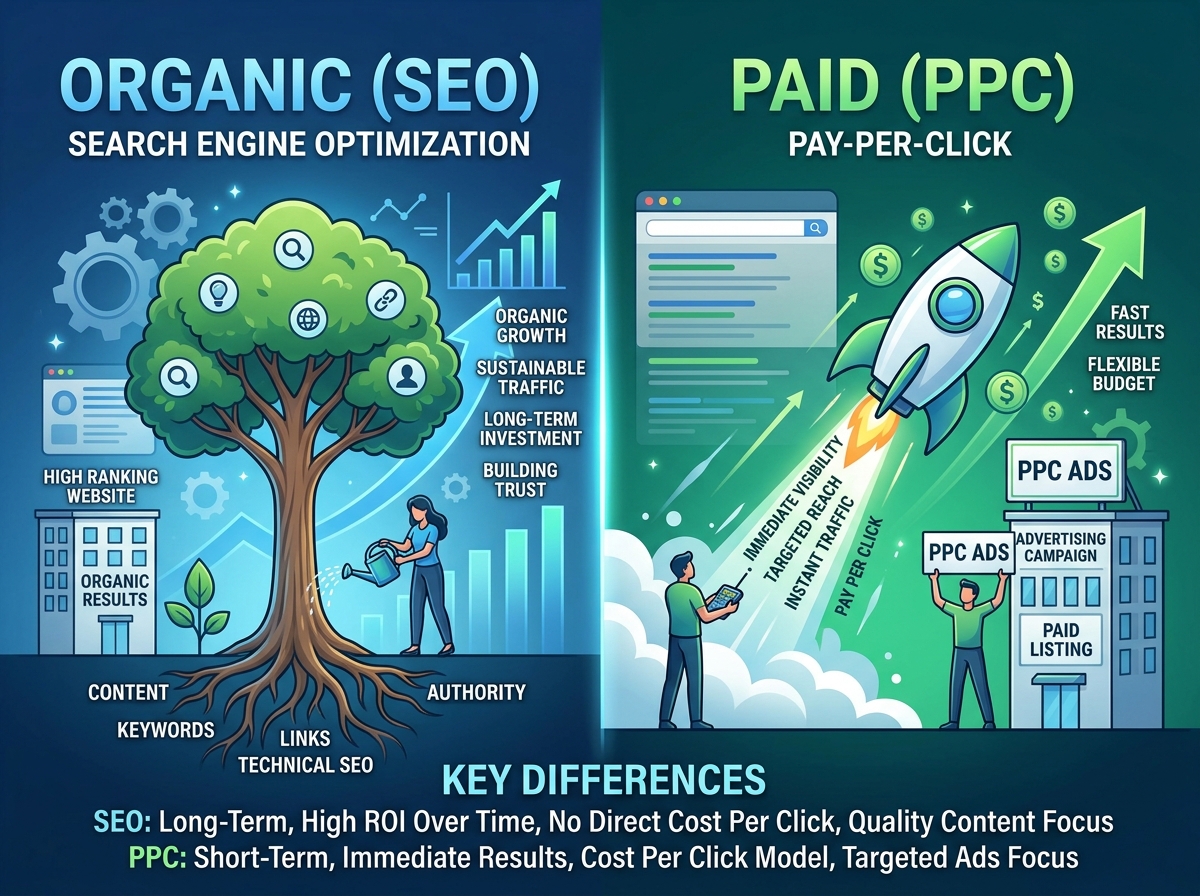
This shift is what we call Generative Engine Optimization (GEO). While what is search engine optimization focuses on making your site readable for a crawler that indexes pages, GEO focuses on making your brand’s information “digestible” for an AI that synthesizes answers.
The rise of “zero-click” searches means users often get their answers directly on the search page without ever visiting your site. A Search Engine Land study on organic click decline predicts that generative search could cause an 18% to 64% decline in organic clicks. If you aren’t the one being cited in that AI response, your visibility effectively vanishes.
| Feature | Traditional SEO | Generative Engine Optimization (GEO) |
|---|---|---|
| Primary Goal | High rankings in “Blue Links” | Being cited/recommended in AI responses |
| Main Metric | Organic Traffic & Click-Through Rate | AI Sourcing Rank & Citation Frequency |
| Content Focus | Keyword density & Backlinks | Topical Authority & Entity Relationships |
| User Experience | Page speed & Site structure | Natural Language & Conversational Intent |
| Search Result | List of relevant websites | Synthesized, conversational answer |
Why Your Business Needs Generative AI SEO Services Now
The numbers are hard to ignore. ChatGPT alone processes over 1 billion daily queries from more than 122 million users. When you add in Gemini, Perplexity, and the fact that Google AI Overviews now cover 65% of searches, the traditional search funnel is being bypassed.
Many local business owners across the country are seeing their traffic dip. This is because AI models prioritize “owning the answer.” If a user asks, “Who is the best plumber near me?” and the AI provides a single, confident recommendation with a brief summary of reviews, the user has no reason to scroll down to the traditional results.
Staying visible requires a proactive approach. We are seeing that ChatGPT Ads and AI-driven recommendations are the next frontier. By investing in generative ai seo services, you aren’t just chasing traffic; you are future-proofing your brand’s reputation so that when an AI “thinks,” it thinks of you.
5 Core Strategies to Improve AI Visibility and Citations
How do you actually get an AI to mention your brand? It’s not about “gaming” the system; it’s about becoming a trusted entity in the AI’s knowledge graph.

1. Build Deep Topical Authority
AI engines don’t just look for keywords; they look for expertise. Instead of writing broad, shallow blog posts, we focus on creating “clusters” of content that prove you are the definitive source for your niche. If you provide local services, this means having exhaustive resources on every aspect of your trade.
2. Master Technical Optimization and Schema
Structured data is the “language” of AI. By using advanced schema markup, you tell the LLM exactly what your business does, where you are, and what people think of you. This is why understanding what is NAP and why it’s critical for local SEO is more important than ever. If your Name, Address, and Phone number are inconsistent across the web, the AI will perceive you as an unreliable entity and skip over you.
3. Entity Benchmarking and Sentiment Analysis
AI models perform sentiment analysis on your brand. They look at reviews, forum mentions, and news articles to decide if you are a “good” recommendation. We use generative ai seo services to monitor this narrative. If the AI sees a “narrative drift”—where your brand is being associated with outdated or negative information—we work to correct that footprint through digital PR and reputation management.
4. Optimize for Local AI Signals
For local businesses, local signals are the lifeblood of AI recommendations. LLMs pull heavily from Google Business Profiles and local directories. Our approach to AI and Local SEO GBP ensures that your profile is optimized not just for humans, but for the data harvesters that feed AI models.
5. Prioritize Authentic Editorial Content
Traditional PR tactics, like blasting duplicate press releases across low-quality sites, are actually risky in the GEO landscape. AI engines are smart enough to identify duplicate content and often ignore it. They prioritize authentic, high-trust editorial content. One mention in a reputable local news outlet is worth more to an AI than a hundred “spammy” backlinks.
Measuring Success: Key Metrics for the AI Era
If traffic is down 20%, but your sales are up, does it matter? In the AI era, we have to look at new metrics to measure the ROI of generative ai seo services.
- AI Sourcing Rank: How often does ChatGPT or Gemini list your website as a source for its answer?
- Citation Frequency: Are you being mentioned by name, or is the AI just using your data without credit?
- Share of Model: In a specific category (e.g., “Monroe NC Marketing Agencies”), what percentage of the AI’s recommendations include your brand?
- Brand Sentiment: Is the AI’s “opinion” of your brand improving over time?
- AI Visibility Score: Tools like the Amplitude AI visibility tool are starting to offer free ways to baseline how “visible” you are to these models.
At Dietz Group, our average client sees an ROI of 450% from these strategies. We don’t just look at clicks; we look at high-intent leads that come from being the “trusted answer” provided by an AI.
Frequently Asked Questions about AI SEO
What is the difference between SEO and GEO?
SEO (Search Engine Optimization) is about ranking in a list of results on a search engine like Google. GEO (Generative Engine Optimization) is about ensuring your brand is the information the AI uses to create its answer. SEO gets you on the page; GEO gets you in the answer.
How can my brand get cited in ChatGPT or Gemini responses?
The best way is to build high topical authority and use clear structured data. AI models cite sources they view as authoritative and easy to parse. If your site has the most comprehensive, well-structured answer to a specific question, the AI is more likely to reference you.
Are traditional SEO tactics still relevant in the AI era?
Absolutely. In fact, they are the foundation. AI models like ChatGPT often use search APIs (like Google Business Profile) to find information. If your site isn’t technically sound or doesn’t have good backlinks, the AI’s “searcher” won’t find you in the first place. GEO is an evolution of SEO, not a replacement.
Conclusion: Future-Proofing Your Digital Presence
The rise of generative ai seo services represents the biggest shift in digital marketing since the invention of the smartphone. For businesses, the choice is clear: adapt to how people are searching now, or risk becoming invisible as AI Overviews take over the screen.
At Dietz Group, we bring over 18 years of expertise to the table. We don’t just track trends; we implement high-ROI strategies that focus on high-intent searches. Whether you need a Local Generative Engine Optimization Agency to handle your local presence or a partner to help you scale through programmatic AI content, we are here to ensure your brand “owns the answer.”
The “blue links” aren’t dead, but they have company. It’s time to make sure your business is the one the AI recommends. Let’s build your AI visibility together.