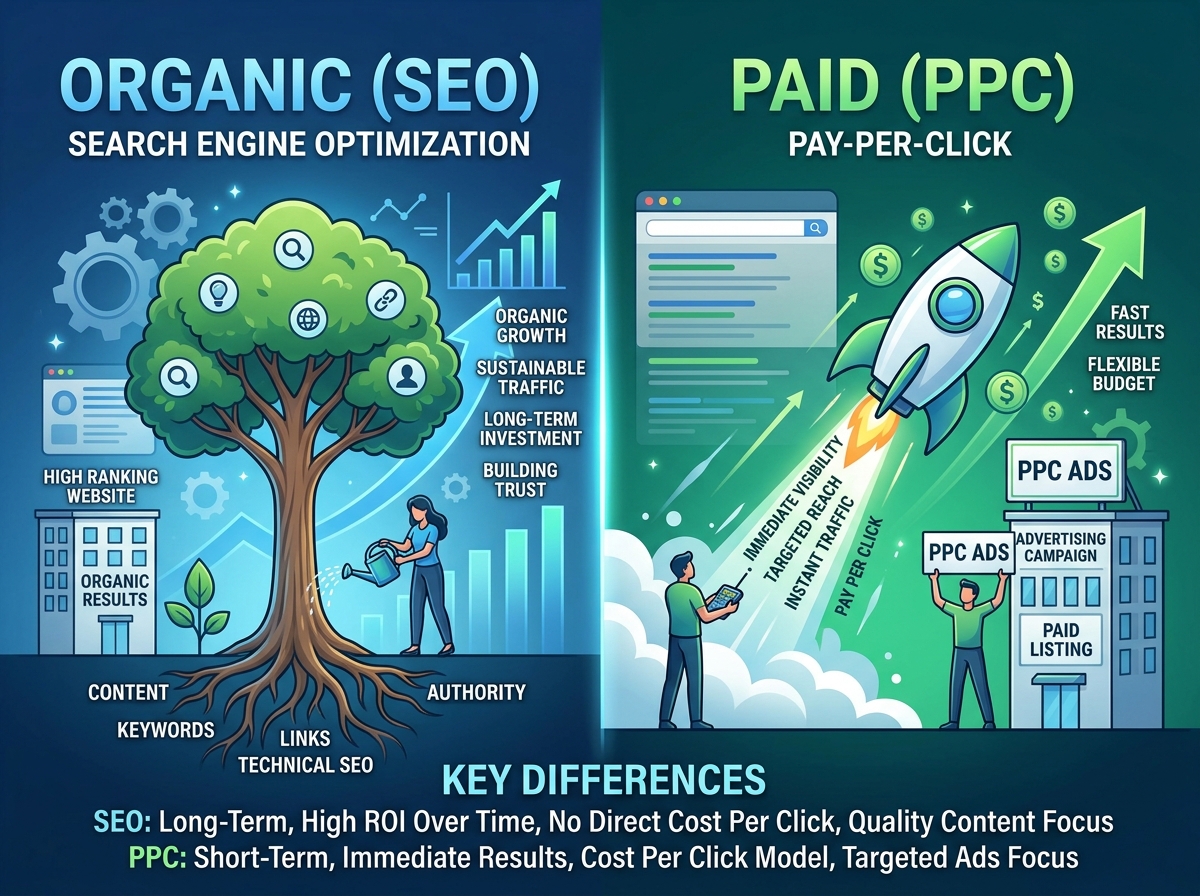
The Real Difference Between SEO and PPC (And Why It Matters for Your Business)
What is the difference between SEO and PPC? Here’s the short answer:
| SEO | PPC | |
|---|---|---|
| What it is | Earning free, organic search rankings | Paying for ads at the top of search results |
| Cost | Time and effort (no cost per click) | You pay each time someone clicks your ad |
| Speed | Takes months to build | Results start immediately |
| Longevity | Traffic continues after work stops | Traffic stops when you stop paying |
| Trust | Often seen as more credible by users | Clearly labeled as an ad |
| Best for | Long-term growth and brand authority | Quick wins, promotions, and targeted campaigns |
Both strategies help your business show up when people search online. They just get there in very different ways.
Every day, Google processes over 8.5 billion searches. Your potential customers are out there, searching for exactly what you offer. The question is: are you showing up?
Search Engine Optimization (SEO) and Pay-Per-Click (PPC) advertising are the two main ways businesses answer that question. They live side by side on every Google results page — one earned, one bought. But knowing which one is right for your business (or how to use both) can feel overwhelming, especially when you’re busy running day-to-day operations.
This guide cuts through the noise.
I’m Rob Dietz, founder of the Dietz Group and a Google Ads Search Partner who has been managing Google marketing campaigns since 2008. Over nearly two decades, I’ve helped business owners just like you understand what is the difference between SEO and PPC — and more importantly, how to use that knowledge to actually grow. Let’s dig in.
What is the Difference Between SEO and PPC?
When you type a query into Google, the results page (SERP) is divided into two primary territories. At the very top (and sometimes the bottom), you’ll see listings labeled “Sponsored.” This is the PPC section. Below those ads are the “organic” results, which are earned through SEO.
The fundamental what is the difference between seo and ppc comes down to how you “pay” for that space. With PPC, you are essentially renting visibility. You bid on specific keywords, and every time a curious user clicks your link, a small fee is deducted from your budget. It’s direct, measurable, and fast.
SEO, on the other hand, is like owning a home rather than renting an apartment. You don’t pay Google for the clicks, but you do invest heavily in the “renovations”—the content, the technical structure, and the reputation of your site. While 94% of users reportedly ignore paid search results in favor of organic ones, those organic spots are much harder to claim.
| Feature | SEO (Organic) | PPC (Paid) |
|---|---|---|
| Placement | Middle/Bottom of SERP | Top/Bottom of SERP |
| Cost Structure | Investment in content/tech | Pay-per-click (bidding) |
| Timing | 12–18 months for major results | Instant visibility |
| Sustainability | High (compounds over time) | Low (stops when budget ends) |
| Control | Search engines decide ranking | You control copy, budget, and timing |
For a deeper dive into which path fits your current business stage, check out our breakdown on SEO vs PPC – Which Should You Use?.
Breaking Down the Mechanics: How Search Marketing Works
To truly master the what is the difference between seo and ppc, we have to look under the hood. Both methods rely on keywords, but they handle them very differently. Google’s primary goal is to provide the most relevant answer to a user’s question. Whether you are paying for an ad or trying to rank organically, relevance is your golden ticket.
Understanding SEO: The Long-Term Organic Strategy
SEO is the art and science of making your website attractive to search engine algorithms. It isn’t just about mentioning a keyword fifty times; in fact, that’s a great way to get penalized. Modern SEO is built on three pillars:
- On-Page SEO: This is the content people read. It involves What is Search Engine Optimization?—creating high-quality, helpful articles that answer specific questions.
- Technical SEO: This is the “engine” of your site. Is it fast? Is it mobile-friendly? Can Google’s bots “crawl” it easily? You can track this performance using Search Console.
- Off-Page SEO: This is your digital reputation. When other reputable sites link back to you (backlinks), Google sees it as an endorsement.
The goal is to increase your “Authority Score.” For example, a high-authority domain can rank for new keywords almost instantly, whereas a new site might take months to be noticed. You can how Google organic search works by focusing on user intent—are they looking for information or ready to buy?
Understanding PPC: The Power of Immediate Visibility
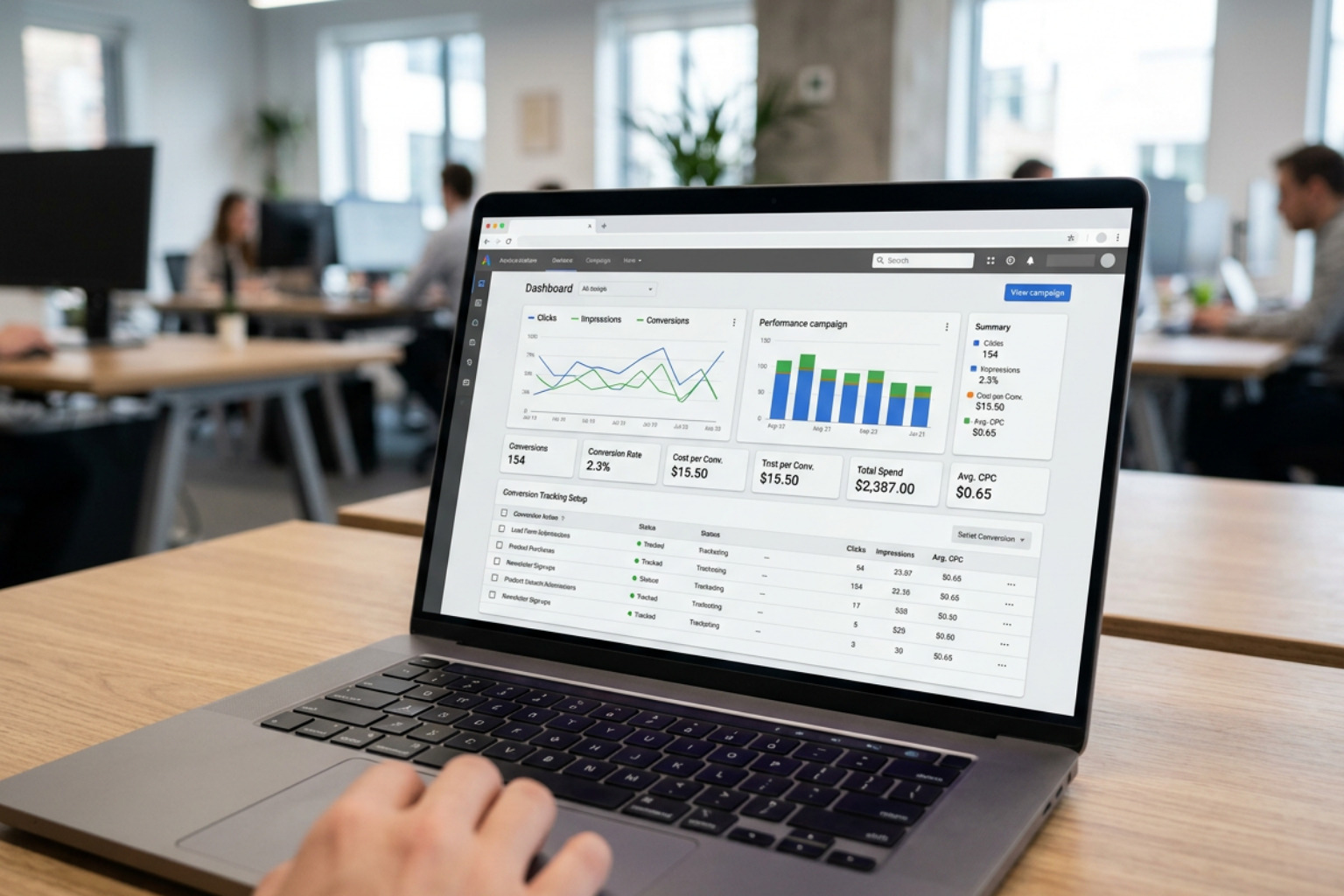
If SEO is a marathon, PPC is a sprint. Using platforms like Google Ads, we can put your business in front of customers the very moment they search for your services.
What is PPC and How Does it Work? It’s an auction-based system. However, the highest bidder doesn’t always win. Google uses a “Quality Score” to ensure ads are actually helpful. If your ad is relevant and your landing page is great, you might pay less per click than a competitor with a bigger budget but a worse website.
Understanding Google PPC and Pay-Per-Click Advertising allows us to target specific demographics, locations (like Monroe, NC), and even times of day. This precision makes it an incredible tool for seasonal promotions or launching a new service where you can’t afford to wait six months for organic traffic to kick in.
The Impact of AI Overviews and Shifting Search Behavior
The search landscape changed forever in 2024 with the introduction of AI Overviews (AIO). Now, for many queries, Google provides a generative AI summary at the top of the page, often pushing both ads and organic links further down.
Recent data shows that when AI Overviews appear, users click on traditional links just 8% of the time, compared to 15% when they are absent. This has led to a rise in “zero-click searches,” where the user gets their answer without ever visiting a website.
However, it’s not all doom and gloom. Branded searches—where someone specifically looks for your company name—have actually seen an 18% increase in click-through rates despite AI. Furthermore, SEO is becoming the foundation for AI visibility. If your content is authoritative and well-structured, the AI is more likely to cite you as a source, which is the new “ranking #1.”
For PPC, the impact is also significant. Paid click-through rates on informational queries with AI Overviews fell to 6.34% recently. This means advertisers must focus more on “high-intent” commercial keywords—searches where an AI can’t replace the experience of buying a product or booking a local service.
Strategic Integration: Using SEO and PPC Together
We often hear people ask, “Should I do SEO or PPC?” Our answer is almost always: Yes.
When you use them together, the results aren’t just doubled; they’re multiplied. This is called a holistic search strategy. By appearing in both the paid and organic sections, you dominate the “SERP real estate,” which builds massive trust. If a user sees you twice, they assume you are the industry leader.
Is Is Paying for SEO Worth It? Absolutely, especially when it works in tandem with your paid efforts. You can use PPC to “buy” your way to the top for keywords that are too competitive to rank for organically, while your SEO builds a long-term asset that reduces your reliance on ad spend over time.
Leveraging PPC Data to Refine What is the Difference Between SEO and PPC Strategies
One of the smartest moves we make for our clients is using PPC as a testing ground for SEO. Since PPC provides instant data, we can see which headlines get the most clicks and which keywords actually lead to phone calls or sales.
Why Combining Google Ads and Local SEO is a Good Strategy involves taking those winning PPC keywords and building long-term SEO content around them. Why guess what your customers want when your ad data tells you exactly what they’re clicking on? This reduces the risk of spending months writing content that doesn’t convert.
Maximizing SERP Real Estate: What is the Difference Between SEO and PPC Visibility
“Double-dipping” on the search results page is a powerful psychological trigger. When your business appears in the local map pack (SEO) and a top-of-page ad (PPC), you create a “surround sound” effect for your brand.
This is also a vital defensive strategy. Competitors can bid on your brand name in PPC to try and steal your customers. By running a small brand-protection ad campaign alongside your strong organic presence, you ensure that when someone looks for you, they find you—not the guy down the street.
Frequently Asked Questions about SEO and PPC
Is SEO or PPC more cost-effective in the long run?
SEO is generally more cost-effective over time. While the initial investment in content and technical fixes can be high, the traffic it generates is “free” once you rank. For example, some major industry blogs have organic traffic values equivalent to millions of dollars in monthly ad spend. However, PPC is more cost-effective for immediate sales or short-term promotions where the “cost per lead” is justified by a high-profit margin.
How long does it typically take to see results from SEO vs PPC?
PPC results are nearly instantaneous; once your campaign is live and your bids are set, you can start seeing traffic within hours. SEO is a “slow burn,” typically taking 12 to 18 months (or more, depending on the age of the business, market, and level of competition) to show significant ranking improvements. This is why we often recommend starting with PPC to generate revenue while the SEO “engine” warms up.
Can PPC data inform SEO keyword research?
Yes, and it should! PPC provides a “search term report” that shows the exact phrases people typed before clicking your ad. This is a goldmine for SEO. If you see a specific long-tail question converting well in your ads, you should immediately create a dedicated blog post or FAQ page for that topic to capture that traffic organically for free.
Conclusion
Understanding what is the difference between seo and ppc is the first step toward digital dominance. At Dietz Group, we don’t believe in a one-size-fits-all approach. Whether you need the immediate lead generation of a targeted SEM campaign or the long-term authority of local SEO and GEO strategies, we use our 18+ years of expertise and cutting-edge AI technology to ensure you’re not just spending money—you’re investing in growth.
Ready to stop guessing and start growing? Let’s build a strategy that puts your business exactly where it belongs: at the top.
For businesses that want faster results, a Google Ads Management Agency can help turn PPC spend into measurable leads.