
Why Google Star Ratings Can Make or Break Your Local Business
Boosting your Google star ratings is one of the highest-impact moves you can make for your local business’s online visibility and revenue. Here’s a quick breakdown of how to do it:
- Claim and optimize your Google Business Profile
- Ask for reviews via SMS, QR codes, or email — right after a positive experience
- Respond to every review, positive or negative, within a week
- Fix the issues that are causing negative feedback
- Build review volume consistently over time to dilute low ratings
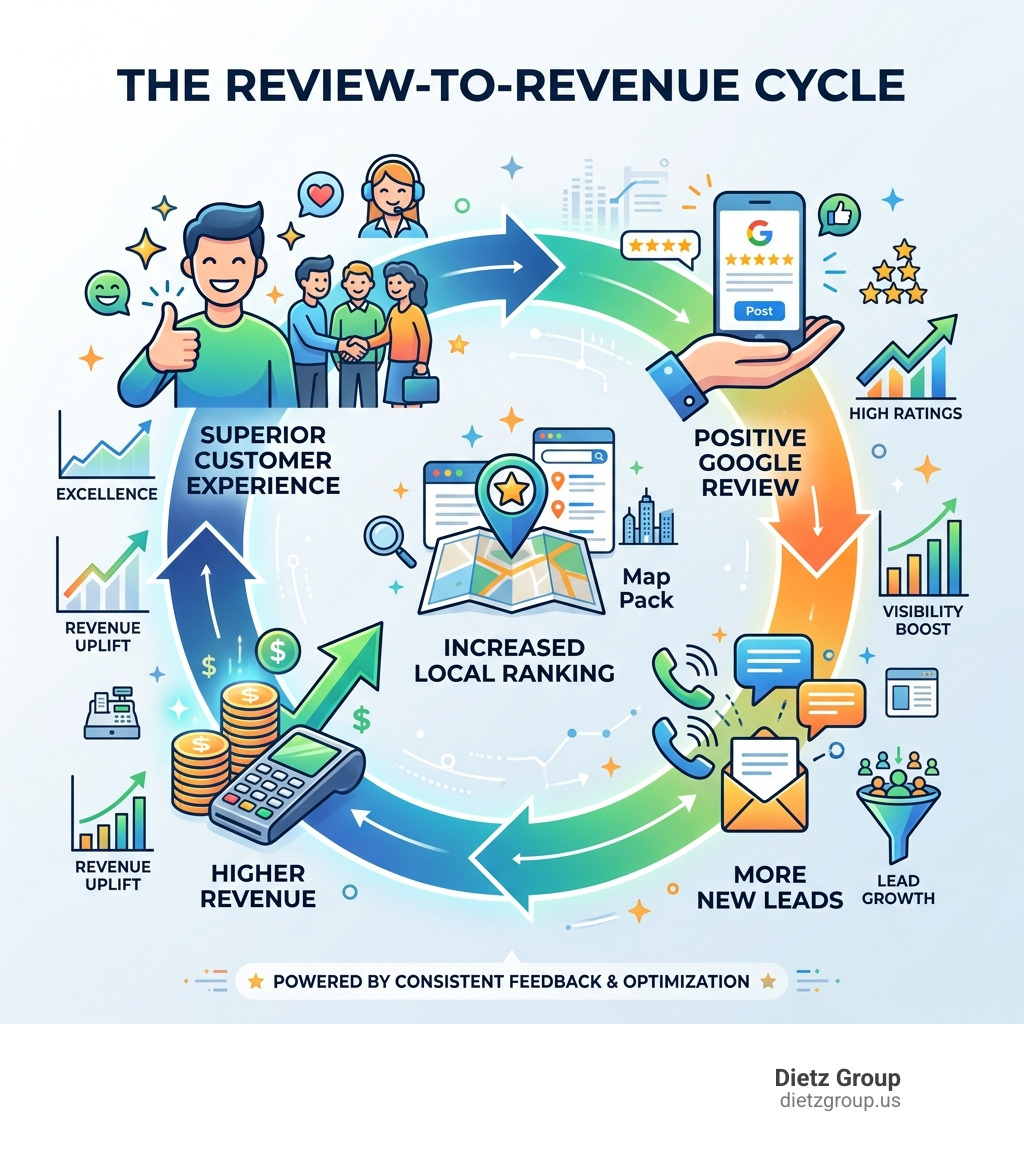
Think about this for a moment: over 81% of consumers rely on Google to shape their purchasing decisions. And 63.6% check Google reviews before visiting a business. That means your star rating is often the first — and sometimes only — thing a potential customer sees before deciding whether to call you or your competitor.
Reviews aren’t just social proof anymore. They directly influence where your business shows up in local search results. Businesses with more positive ratings and higher review volume are simply more visible on Google Maps and in local search.
The challenge? Most satisfied customers won’t leave a review unless you ask them to. Meanwhile, a handful of negative reviews can drag your rating down fast — especially when you don’t have many reviews to begin with.
I’m Rob Dietz, a digital marketing consultant with over 18 years of experience helping local businesses grow their online presence, and boosting Google star ratings is one of the most consistent levers I’ve seen drive real, measurable results for small business owners. Let’s walk through exactly how to do it right.
Understanding the Google Star Rating Algorithm
To effectively boost google star ratings, we first need to understand the “brain” behind the curtain. Many business owners assume their rating is a simple real-time average, but it’s a bit more nuanced than that.
The Arithmetic Mean and Calculation
At its core, the Google star rating is an arithmetic mean of all the reviews your business has received on its Google Business Profile. If you have ten 5-star reviews and ten 1-star reviews, your average will sit at 3.0. However, Google’s algorithm is designed to ensure the integrity of these ratings. It filters out what it deems to be “spam” or “fake” reviews, which can sometimes lead to a discrepancy between the number of reviews you see and the final score displayed.
The 2-Week Update Lag
One common source of frustration for our clients is the “disappearing” or “delayed” review. It is important to know that Google star ratings are not always updated in real-time. There is often a lag of up to two weeks before a new batch of reviews reflects in your overall score. This is because Google’s systems are busy verifying the legitimacy of the feedback. If you just ran a massive campaign to get 20 new reviews, don’t panic if your score doesn’t budge by tomorrow morning.
Your Google Business Profile: The Foundation
Your star rating lives on your Google Business Profile (GBP). This is the digital storefront that appears in Google Maps and local search results. You cannot have a star rating without a verified profile. Beyond just collecting stars, you need to ensure your profile is fully filled out. To get the most out of your presence, check out these 3 Tips to Optimize Your Google Business Profile. A well-optimized profile provides the context Google needs to display your stars to the right people at the right time.
Why You Must Boost Google Star Ratings for Local SEO
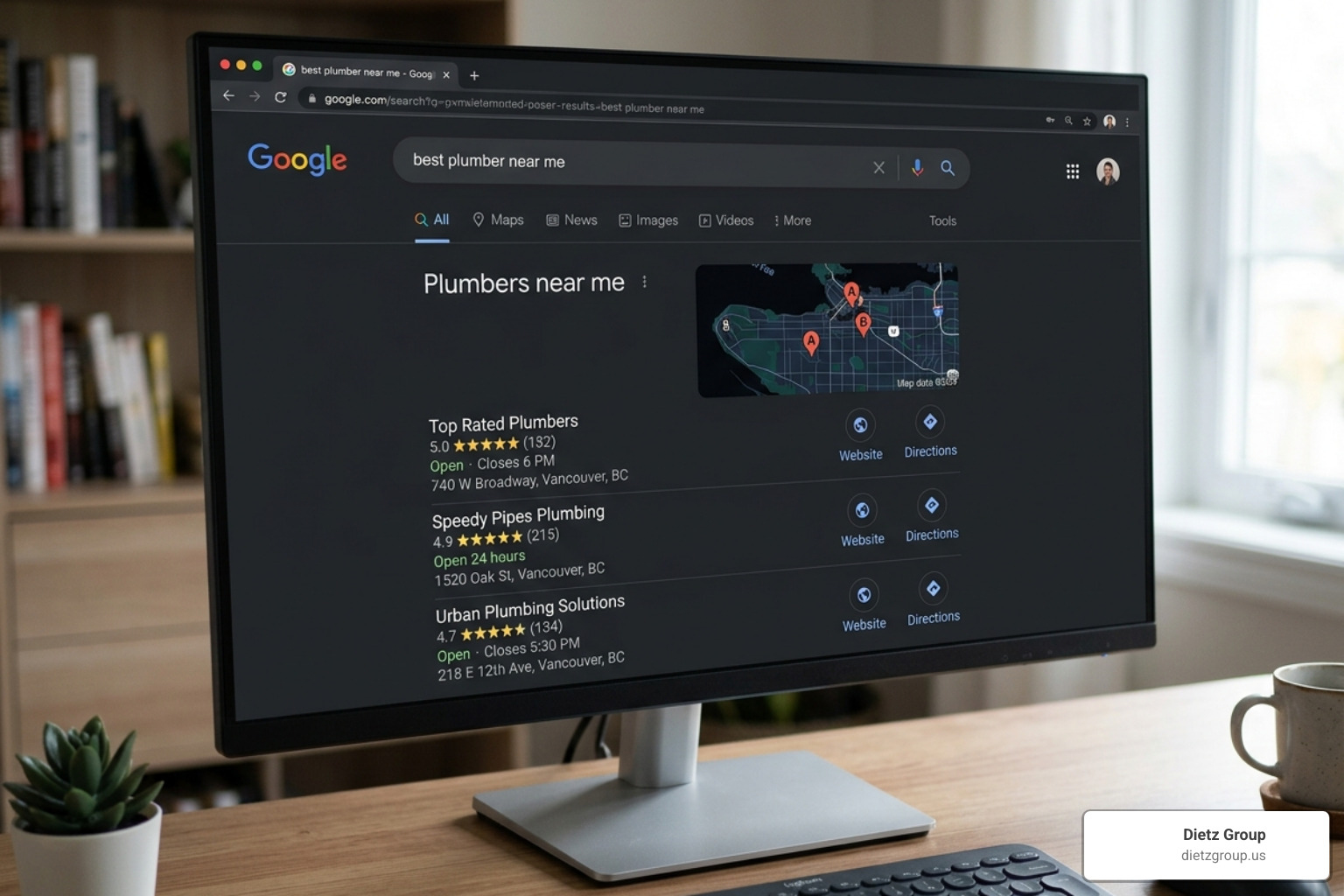
In digital marketing, we often talk about the “Local Pack”—that box of three business listings that appears at the top of a Google search. Appearing here is the “Holy Grail” of local search.
Prominence, Relevance, and Distance
Google uses three primary pillars to determine local rankings:
- Relevance: How well your business matches the searcher’s intent.
- Distance: How close you are to the person searching.
- Prominence: How well-known and trusted your business is.
Boosting google star ratings directly impacts Prominence. Google explicitly acknowledges that a high number of reviews and positive ratings improve a business’s local ranking. Essentially, Google wants to recommend the best businesses to its users. If you have a 4.8-star rating with 500 reviews, Google views you as a “safer” bet than a competitor with a 4.0 and only 10 reviews.
Click-Through Rates (CTR) and AI Search
Beyond just “ranking,” stars act as a visual psychological trigger. A high star rating acts as a beacon that draws the eye. Research shows that brands can see a threefold increase in conversion rates when customers are exposed to a significant volume of reviews.
This becomes even more critical with the rise of AI-powered search. Tools like Vertex AI Search allow developers to “boost” results based on specific attributes like star ratings. As Google moves toward a more generative search experience (GEO), these reviews serve as “digital provenance”—verifiable proof that your business is legitimate and high-quality, which AI systems use to build trust in their answers.
Proven Strategies to Ethically Boost Google Star Ratings
You can’t just sit back and hope people leave reviews. You have to be proactive. However, “proactive” doesn’t mean “pushy” or “shady.” We focus on frictionless, ethical methods to capture the “silent majority” of happy customers.
Leveraging SMS and QR Codes to Boost Google Star Ratings
If you want a review, you have to make it easy. Asking a customer to “Go to Google, search for us, find the review button, and write something” is a recipe for failure.
- SMS Invites: Text message invites are the undisputed king of review generation. Data shows that text invites can result in 15x more Google reviews than traditional email-based platforms. Why? Because we check our phones constantly, and a text with a direct link reduces the “friction” to a single tap.
- QR Codes: For businesses with physical locations, QR codes are essential. Place them on receipts, table tents, or at the checkout counter. A simple “Scan to share your experience” allows the customer to start the review process while the positive experience is still fresh in their mind.
Timing and the “Point of Delight”
The best time to ask for a review is at the “point of maximum delight.” For a contractor, this is right after the final walkthrough when the homeowner is admiring the new kitchen. For a retail store, it’s immediately after the purchase. If you wait three weeks, the emotional connection has faded, and the request becomes an errand.
First-Party Reviews and Email Signatures
While Google reviews are the priority, collecting “first-party” reviews on your own website is also beneficial. It builds your own site’s authority and provides content for search engines to crawl. Additionally, don’t overlook your daily communications. Adding a “Review us on Google” link to your team’s email signatures is a passive but effective way to get more 5-star reviews.
How Negative Responses Help Boost Google Star Ratings
It sounds counterintuitive, but negative reviews are actually an opportunity to boost google star ratings in the long run.
Nearly 96% of customers specifically seek out negative reviews to see how a business handles conflict. If you ignore a bad review, you look indifferent. If you respond professionally, you look like you care. In fact, 56% of consumers say that a business’s response to a review changed their perspective on that business.
When you get a “stinker,” follow these steps:
- Respond quickly: Aim for a 24-hour window (at most, one week).
- Stay professional: Never get defensive. Use the reviewer’s name.
- Take it offline: Provide a phone number or email to resolve the issue privately.
- Fix the root cause: If three people complain about the wait time, you don’t have a review problem; you have a staffing problem.
For a deeper dive into this, read our guide on What to Do If You Get a Negative Online Review.
Common Pitfalls and Policy Violations to Avoid
In the rush to boost google star ratings, many businesses take shortcuts that end up getting them banned. Google is incredibly good at detecting fraudulent patterns. If you get caught, your entire profile—and all the hard-earned SEO progress you’ve made—could be suspended.
| Strategy | Ethical (Do This) | Prohibited (Avoid This) |
|---|---|---|
| Incentives | Asking for feedback because you value it. | Offering a “free coffee” or discount for a 5-star review. |
| Gating | Asking everyone for a review. | Sending a private survey first and only “inviting” the happy people to Google. |
| Velocity | Building reviews steadily over months. | Getting 50 reviews in one day after having zero for a year. |
| Solicitation | Asking customers you’ve actually served. | Buying reviews from “farms” or asking friends/family who haven’t used the service. |
Selective solicitation (only asking people you know will give a 5-star rating) is technically against Google’s terms. While it’s harder for them to track, it’s better to build a system that encourages all feedback. This builds a more “natural” and trustworthy profile.
Frequently Asked Questions About Google Ratings
How long does it take for new reviews to affect my star rating?
As mentioned, there is a verified “update lag.” While a review might appear on your profile within minutes, the actual numerical “star” average at the top of your listing may take several days or up to two weeks to recalculate. Google’s algorithm periodically “sweeps” profiles to update these totals.
Is a perfect 5.0 rating better than a 4.8 rating?
Surprisingly, no. A perfect 5.0 rating with 100 reviews can actually look “too good to be true” to savvy consumers. Most shoppers consider a rating between 4.5 and 4.8 to be the most trustworthy. It shows you are excellent but human. 96% of people look for negative reviews; they want to see that your business is real and transparent.
Can Google remove unfair or fake reviews?
Yes, but it isn’t easy. Google will only remove reviews that violate their specific policies (e.g., spam, hate speech, conflicts of interest, or “off-topic” rants). You can flag a review through your Google Business Profile dashboard. While the removal rate is roughly 30-40% for flagged reviews, it is always worth trying if the review is clearly fraudulent.
Conclusion: The Long Game of Digital Reputation
At Dietz Group, we have over 18 years of expertise in helping businesses navigate the complexities of local search. We know that boosting google star ratings isn’t just about a one-time “push.” It’s about building a sustainable system of trust and authority.
Our approach combines high-ROI AI technology with proven local SEO strategies. However, we always set realistic expectations: a truly effective SEO and reputation campaign takes 12-18 months to see full, dominating results. This isn’t a “quick fix”—it’s a foundational business asset.
If you are ready to take control of your online reputation and ensure your business doesn’t just show up, but stands out, we are here to help. Our “Be Found Framework” is designed to optimize your digital presence for the modern era of AI and high-intent search.
Ready to dominate your local market? Boost your local search visibility and let us help you turn those stars into sales.