Why the Difference Between SEO and PPC Keywords Matters for Your Business
The difference between seo and ppc keywords comes down to one core idea: how and when you want to show up in search results.
Here’s a quick breakdown:
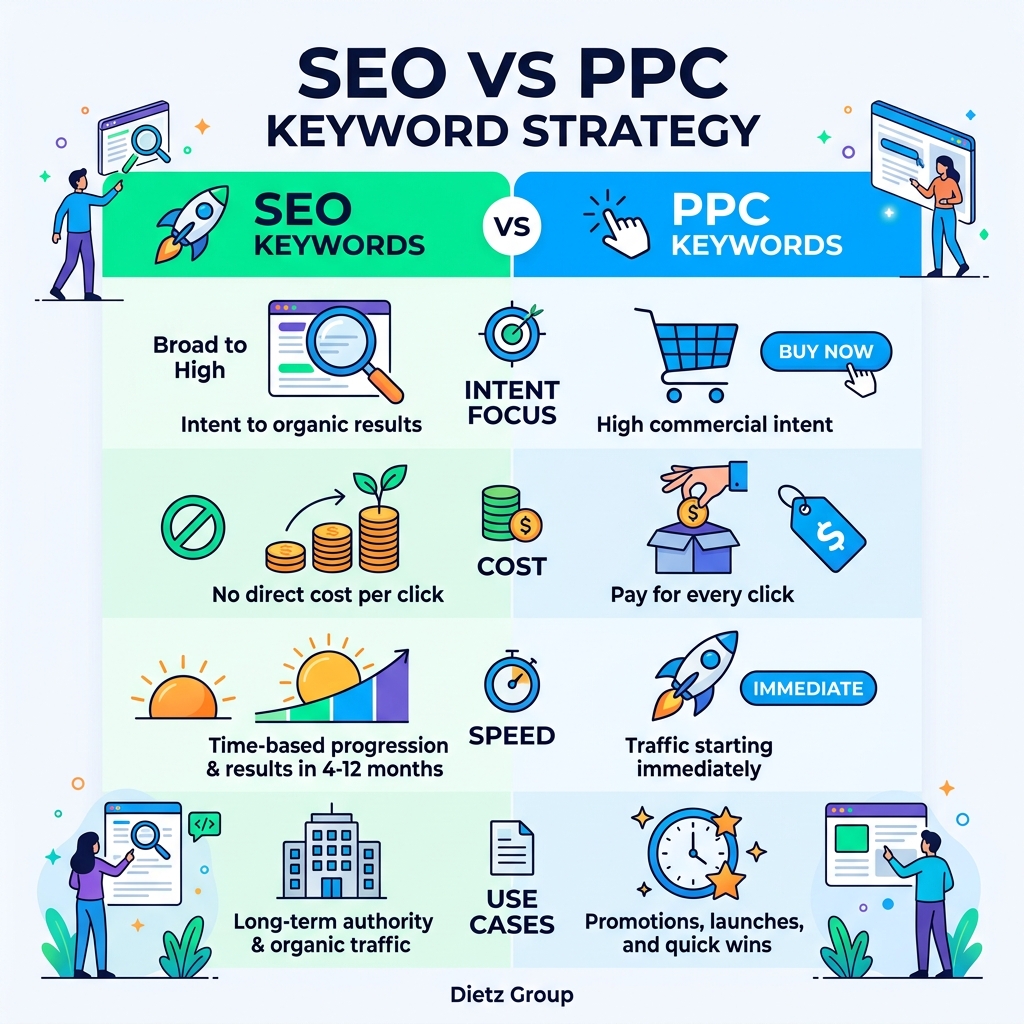
| Factor | SEO Keywords | PPC Keywords |
|---|---|---|
| Cost | No direct cost per click | You pay for every click |
| Speed | Results take 4-12 months | Traffic starts immediately |
| Intent focus | Broad to high intent | High commercial intent only |
| Goal | Long-term organic traffic | Immediate conversions |
| Control | Limited (Google decides) | Full targeting control |
| Best for | Building authority over time | Promotions, launches, quick wins |
The stakes are real. One business spent $150,000 bidding on the keyword “translate” — and got zero clients. Why? The people searching that term wanted a free tool, not a translation service. That’s a classic case of ignoring search intent, and it happens in both SEO and PPC every day.
Google processes over 8.5 billion searches daily. Choosing the right keywords — and knowing which channel to use them in — is what separates wasted budget from real growth.
I’m Rob Dietz, a Google Ads Search Partner and SEO expert with over 18 years of experience helping businesses navigate the difference between seo and ppc keywords to drive real, measurable results. In this guide, I’ll walk you through exactly how to choose the right terms for each channel — and how to make them work together.
Understanding the Difference Between SEO and PPC Keywords
At their core, both SEO and PPC keywords are simply the words and phrases people type into a search engine. However, the difference between seo and ppc keywords lies in how they are treated by search engines and how they impact your bottom line.
SEO keywords are the foundation of Search Engine Optimization. These are terms we weave into your website’s content, headers, and metadata to prove to Google that your page is the most authoritative answer to a user’s query. When you rank for these, the traffic is “free”—meaning you don’t pay Google for the click.
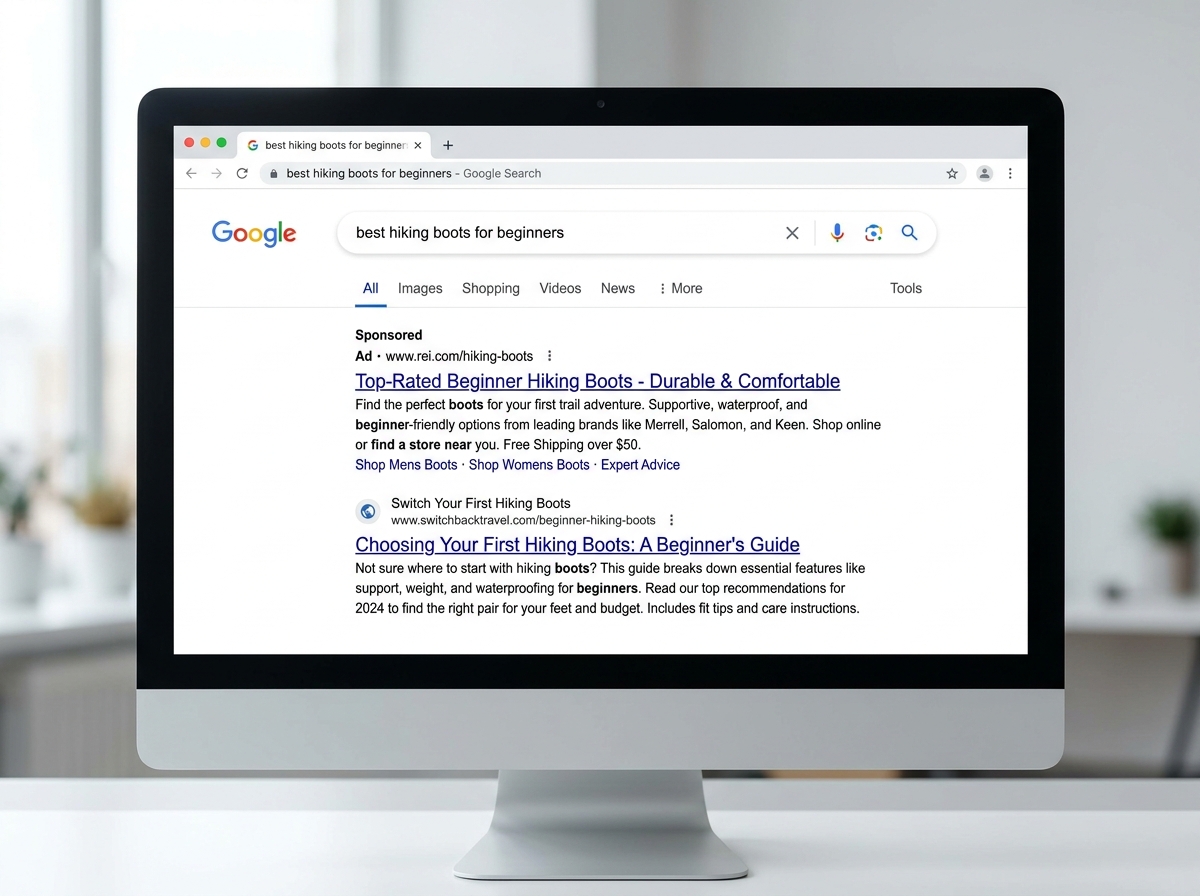
PPC keywords, on the other hand, are the fuel for pay-per-click (PPC) ads. These are terms you bid on in an auction. When a user searches for your chosen PPC keyword, your ad appears at the very top of the page. You only pay when someone actually clicks your link.
The scale of this landscape is massive. Search advertising accounts for roughly 42% of digital marketing revenue globally. While 94% of users may ignore paid results in favor of organic ones, that remaining 6% of paid clicks often represents users with the highest immediate intent to buy.
Defining the Difference Between SEO and PPC Keywords in Implementation
The way we implement these keywords is where the technical heavy lifting happens. For SEO, we focus on “prominence” and “relevance.” This means placing keywords strategically in your title tags, meta descriptions, and throughout high-quality content that satisfies Google’s Search Quality Evaluator Guidelines.
In Google PPC and Pay-Per-Click Advertising, implementation is about “Match Types” and “Quality Score.”
- Broad Match: Your ad shows for searches related to your keyword.
- Phrase Match: Your ad shows for searches that include the meaning of your keyword.
- Exact Match: Your ad shows only for searches with the same meaning as your keyword.
Unlike SEO, where you hope Google understands your context, PPC gives us surgical control. We can use “Negative Keywords” to prevent our ads from showing for irrelevant terms (like the “translate” example mentioned earlier), ensuring your budget isn’t wasted on tire-kickers.
How SERP Features Influence Keyword Selection
The modern Search Engine Results Page (SERP) isn’t just a list of blue links anymore. It’s a complex map of sponsored labels, rich snippets, knowledge panels, and the “Local Pack.”
When we help businesses get listed at the top of search engines, we have to look at what the SERP actually looks like for a specific keyword. If a keyword triggers a massive “Knowledge Panel” or a “People Also Ask” section, it might be better suited for an SEO long-form guide. If the top of the page is dominated by four high-quality ads and a Local Pack, we might prioritize a PPC campaign and Local SEO to ensure you aren’t buried “below the fold.”
How Keyword Research Strategies Vary by Channel
Keyword research isn’t a “one-size-fits-all” process. The difference between seo and ppc keywords becomes very clear when we look at our goals.
In SEO, we often cast a wider net. We want to build “Topical Authority.” This means targeting informational queries (e.g., “how to maintain a HVAC system”) even if they don’t lead to an immediate sale. These keywords drive volume and build trust, which eventually leads to conversions.
In PPC, we are often more ruthless. Because every click costs money, we prioritize transactional terms (e.g., “HVAC repair Monroe NC”). We look for “long-tail” keywords that are specific and indicate a user is ready to pull the trigger.
Why Search Intent is the Main Difference Between SEO and PPC Keywords
Search intent is the “why” behind the search. It is arguably the most critical factor in determining whether a keyword belongs in your SEO or PPC bucket.
- Low-Intent (Informational): The user wants to learn. (e.g., “What is a heat pump?”)
- Strategy: SEO. It’s too expensive to pay for these clicks in PPC, but they are great for building brand awareness organically.
- High-Intent (Transactional/Commercial): The user wants to buy or hire. (e.g., “emergency heat pump repair near me”)
- Strategy: PPC. You want to be the first thing they see when they have a problem that needs solving now.
A massive mistake businesses make is bidding on low-intent keywords in PPC. If someone is just looking for a definition, they probably aren’t going to buy your $5,000 service today. Paying $10 for that click results in a poor Return on Ad Spend (ROAS).
Analyzing Metrics: Search Volume, CPC, and Difficulty
When we dive into the data, we look at three main numbers:
- Search Volume: How many people are searching for this? High volume is great for SEO traffic but can be incredibly expensive for PPC if the intent isn’t perfect.
- Cost-Per-Click (CPC): How much does it cost to “rent” this keyword? If the CPC is $50, the purpose of Search Engine Optimization becomes clear: we want to rank for that term organically so we don’t have to pay that $50 every time someone clicks.
- Keyword Difficulty (KD%): How hard is it to rank on page one? If the difficulty is 90/100, it might take 12 months to see SEO results. In that case, we use PPC to get you to the top immediately while the SEO “marathon” is running.
Strategic Integration: Should You Target the Same Keywords?
A common question we get at Dietz Group is: “If I rank #1 organically, should I stop paying for the ad?”
The answer is usually no.
Combining Google Ads and Local SEO is a “power move.” When you appear in both the paid slot and the top organic slot, you dominate the SERP. This “double presence” increases trust and significantly boosts your total click-through rate. It also prevents competitors from “conquesting” your brand name by bidding on your keywords to steal your traffic.
Using PPC Data to Inform SEO Content
One of the best “hacks” in digital marketing is using PPC as a testing ground for SEO. SEO takes months to show results, but PPC takes minutes.
We can run an ad for a week to see which headlines get the most clicks and which keywords actually lead to phone calls. Once we have that data, we can pass it to our SEO team. They can then use those high-performing headlines in your meta tags and create content around the keywords that we know convert. This is where technical SEO and data-driven content strategy meet.
When to Prioritize SEO vs. PPC Keyword Strategies
Knowing when to lean into the difference between seo and ppc keywords depends on your business stage and budget.
- Prioritize PPC when: You are launching a new product, running a seasonal sale (like a “Summer AC Tune-up”), or need leads today to keep your team busy.
- Prioritize SEO when: You want to lower your long-term customer acquisition costs, build brand authority, or have a limited monthly budget that can’t sustain high CPCs.
Ideally, you want a combination. PPC provides the “sprint” for immediate revenue, while SEO provides the “marathon” for sustainable, compounding growth.
Cost Implications of Keyword Choices
Let’s talk about the “free” in SEO. SEO isn’t actually free; it requires an investment in time, content creation, and technical expertise. However, once you rank, the marginal cost of a new visitor is zero.
PPC is the opposite. It is highly scalable—if you want more traffic, you just increase the budget. But the moment you stop paying, the traffic disappears. We often see that over a 24-month period, paying for SEO is worth it because the cost per lead eventually drops well below the cost of a PPC lead.
Common Pitfalls in Keyword Selection
Even pros can trip up on the difference between seo and ppc keywords. Here are the most common mistakes we see:
- The “Broad Match” Trap: Bidding on broad terms in PPC (like “shoes”) instead of specific ones (“red running shoes for flat feet”). This is a fast way to burn a budget.
- Keyword Stuffing: Forcing too many keywords into SEO content. Google’s AI is smart enough to know when you’re writing for a bot instead of a human.
- Ignoring Negative Keywords: Not telling Google where not to show your ads. If you sell luxury watches, you should add “cheap” and “free” as negative keywords.
- Mismatched Intent: Sending PPC traffic to a generic homepage instead of a specific landing page that matches the keyword.
Frequently Asked Questions about Search Keywords
Should I bid on keywords I already rank #1 for organically?
Yes, in many cases. It allows you to occupy more “real estate” on the screen, pushes competitors further down the page, and has been shown to increase the overall likelihood of a user clicking on your brand.
What is the biggest mistake in PPC keyword selection?
Ignoring search intent. Just because a keyword is related to your business doesn’t mean the person searching it wants to buy something. Always ask: “Does this person have their credit card in their hand, or are they just looking for a DIY tip?”
How long does it take for SEO keywords to show results?
Typically, it takes 4 to 12 months to see significant movement. This depends on the competition and the current “authority” of your website. This is why we often recommend starting with a hybrid strategy to get leads immediately via PPC while the SEO builds.
Conclusion
Mastering the difference between seo and ppc keywords is the secret to a high-ROI marketing strategy. By understanding that SEO is for building a long-term asset and PPC is for precision-targeted growth, you can stop “combating” the search engines and start dominating them.
At Dietz Group, we’ve spent over 18 years refining this balance. Whether you’re a local business in Monroe, NC, or looking to expand your reach through GEO-fencing and advanced SEM, we have the AI technology and expertise to ensure your keywords are working as hard as you do.
Ready to stop guessing and start growing? Explore our Google Ads Management Agency services today, and let’s build a search strategy that wins.