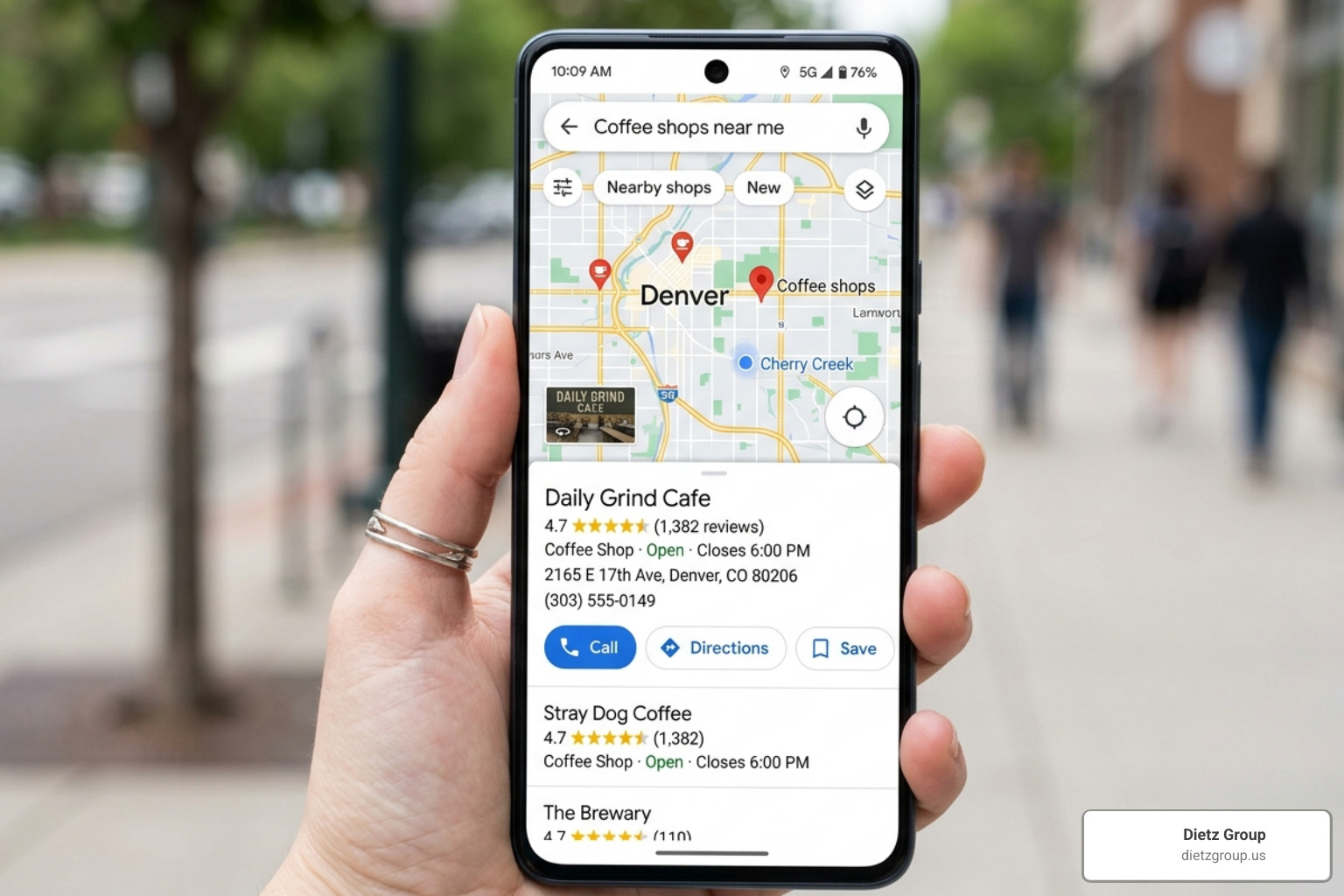
The Three Pillars of Local Search: How Google Ranks Your Profile
Improve GBP ranking is one of the highest-leverage things a local business owner can do to get more calls, visits, and leads from Google. Here’s a quick overview of what it takes:
How to Improve Your Google Business Profile Ranking:
- Claim and fully complete your profile – fill in every field, including hours, categories, and description
- Choose the right primary category – this is the single strongest relevance signal
- Build consistent reviews – aim for a steady flow of 2+ new reviews per week
- Keep your NAP consistent – your Name, Address, and Phone must match everywhere online
- Add photos and post weekly – fresh content signals activity to Google
- Align your website – local keywords, mobile-friendliness, and schema markup all support your profile
- Define your service areas – critical if you don’t have a physical storefront
These seven actions address Google’s three core ranking factors: relevance, distance, and prominence. We’ll break each one down in detail below.
If you’re a local business owner, the reality is stark: 46% of all Google searches are for local information. Your customers are already searching. The question is whether they’re finding you or your competitors.
Most Google Business Profiles (GBP) exist. Very few are actually optimized. That gap is exactly where businesses lose customers every single day without even knowing it.
I’m Rob Dietz, founder of the Dietz Group and a digital marketing consultant with over 18 years of experience helping local businesses grow their online presence – including helping clients improve GBP ranking through proven, no-nonsense local SEO strategies. Let’s walk through exactly what works.
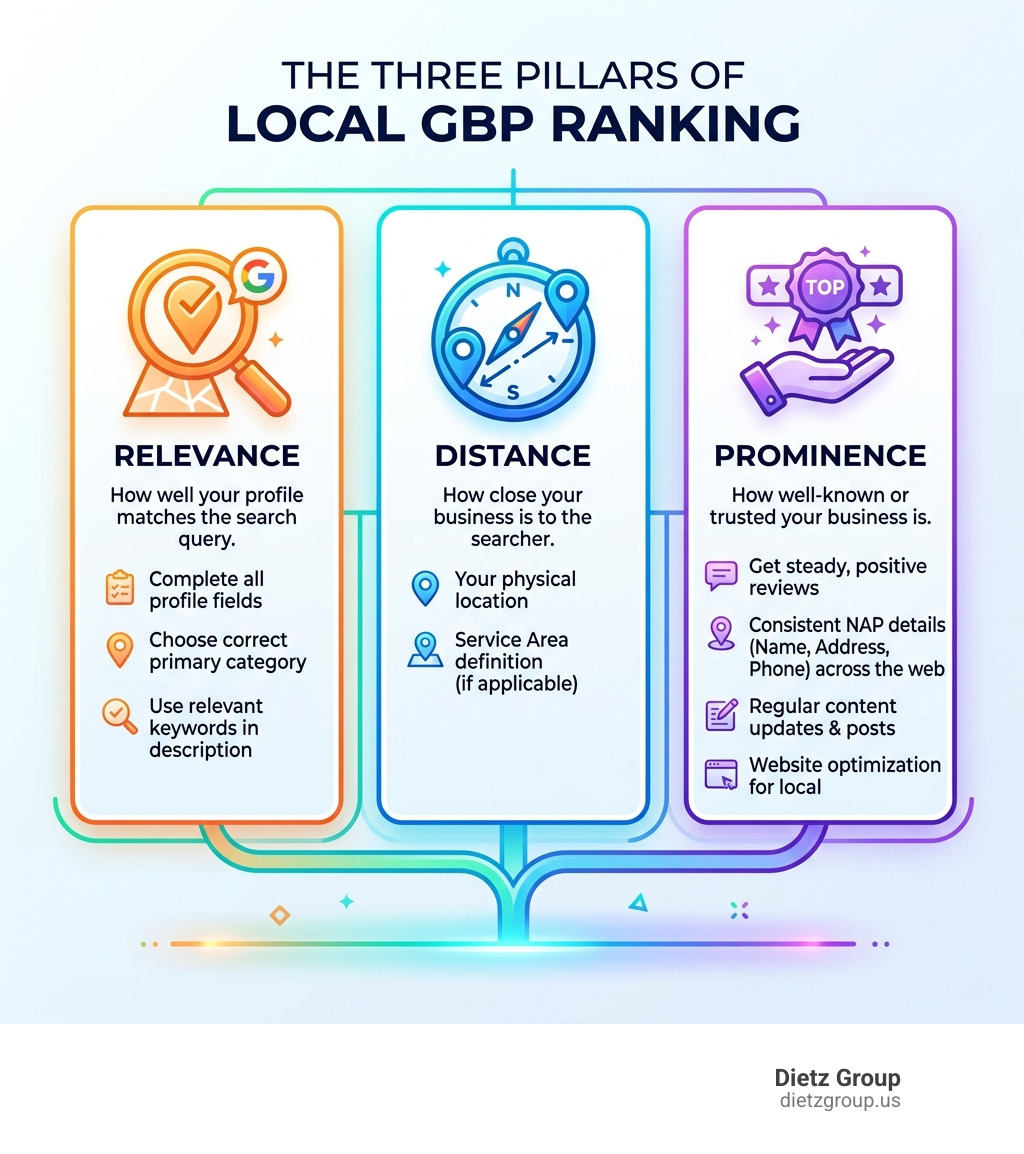
When we talk about how to improve GBP ranking, we have to start with the “Holy Trinity” of local SEO. Google isn’t just picking names out of a hat; it uses a specific algorithm to determine which businesses deserve that coveted top spot. Understanding these three pillars is the foundation of everything we do.
- Relevance: This is how well your business profile matches what someone is searching for. If someone types “emergency plumber,” Google looks for profiles that clearly match that service. This is why what is a Google Business Profile and how you fill it out matters so much. If your profile is vague, Google won’t risk showing you to a searcher.
- Distance: This is exactly what it sounds like – how far your business is from the person searching. While we can’t move your building closer to every customer, we can ensure Google knows exactly where you are and which areas you serve.
- Prominence: This is a measure of how well-known or “important” your business is. Google looks at things like your review count, your star rating, and even how many other websites link to you. Building authority takes time, consistency, and strategy.
Many owners ask, will local SEO make a difference for a small business? The answer is a resounding yes. By focusing on these three factors, you aren’t just “existing” on the web; you’re actively signaling to Google that you are the most relevant, prominent, and accessible choice for the user.
Understanding the Local 3-Pack
If you’ve ever searched for “pizza near me” or “dentist nearby,” you’ve seen the Local 3-Pack. It’s that box at the top of the search results that features a map and three specific businesses.
Why is it so important? Because it captures the vast majority of clicks. Most users never even make it to the “More Businesses” button. Ranking in the 3-Pack is like having a storefront on the busiest intersection in town, whereas ranking on page two is like having a shop in the middle of the woods with no signage. As a local search engine optimization agency, we focus on getting you into that top tier because that’s where the organic traffic and high-intent calls happen.
Step-by-Step Guide to Improve GBP Ranking Through Profile Optimization
To improve GBP ranking, you can’t leave any stone unturned. A half-finished profile signals to Google that you might be out of business or simply don’t care about your digital presence.
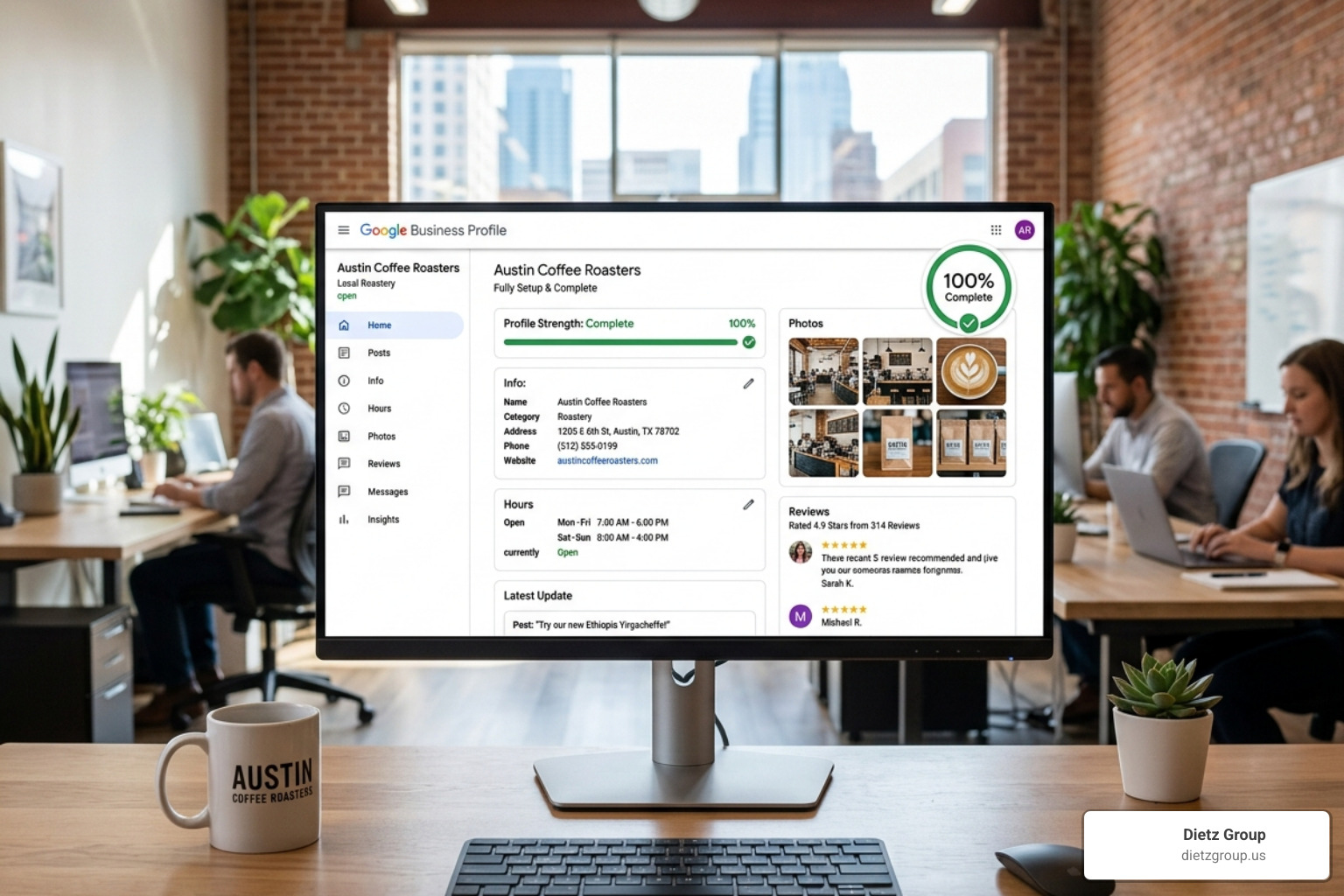
First, you need to know how do I get a Google Business Profile if you don’t already have one. Once you have access, your goal is 100% completion.
- Business Description: You have 750 characters. Use them wisely. Don’t just list your name; explain what you do, who you serve, and why you’re the best. Mention your core services naturally, but avoid keyword stuffing.
- Operating Hours: Keep these updated consistently. There is nothing that kills a customer’s trust faster than driving to a shop that says “Open” on Google but has a “Closed” sign on the door. Google even uses “open now” signals as a ranking factor for real-time searches.
- Attributes: Are you women-led? Do you offer free Wi-Fi? Is your entrance wheelchair accessible? These small details help Google match you with specific user needs.
For more quick wins, check out these 3 tips to optimize your Google Business Profile.
Selecting Critical Primary and Secondary Categories
If your profile optimization were a car, your categories would be the engine. Choosing the wrong primary category is one of the most common – and damaging – mistakes we see.
According to 11 Google Business Profile tips to dominate local SEO – WebPT, your primary category carries the most weight for relevance. If you are a “Dental Implant Surgeon,” don’t just settle for “Dentist” if a more specific category exists.
- Primary Category: Pick the one that most accurately describes your core business.
- Secondary Categories: Use these to fill in the gaps. If you’re a spa, your primary might be “Day Spa,” and your secondary categories could include “Massage Therapist,” “Facial Spa,” and “Nail Salon.”
Be careful not to overdo it. Adding irrelevant categories just to cast a wider net can actually confuse Google’s systems and hurt your rankings.
Leveraging Visual Content to Improve GBP Ranking
Humans are visual creatures. We want to see where we’re going before we get there. Profiles with more photos get significantly more engagement, which in turn signals to Google that your listing is high-quality.
- High-Resolution Photos: Aim for at least 20+ photos. This should include your exterior, your interior, and your team in action.
- Video Content: Videos between 30 and 120 seconds can build trust faster than text alone.
- Verification: Sometimes Google requires video verification to prove you are who you say you are. We’ve seen many owners face challenges with Google Business Profile video verification, but following Google Business Profile video verification tips like ensuring your street sign and tools of the trade are visible can make the process much smoother.
Building Prominence: Reviews, Citations, and NAP Consistency
Once your profile is polished, it’s time to make it powerful. This is where “prominence” comes in. Google wants to recommend businesses that people actually like and trust.
Reviews are the lifeblood of local SEO. But it’s not just about the total number. Google looks at:
- Review Quality: Are people leaving detailed descriptions or just five stars?
- Review Velocity: Are you getting a steady stream of reviews, or did you get 50 three years ago and nothing since? 60 reviews from the last 6 months beat 150 reviews from 3 years ago.
- Review Recency: Fresh reviews signal that your business is currently active and doing a great job.
Managing this can be a full-time job, which is why we created the Ultimate Google Business Profile Management Guide.
Achieving Flawless NAP Consistency Across the Web
NAP stands for Name, Address, and Phone number. Google crawls the web to see if the information about your business matches. If your GBP says one thing but a directory listing says something else, Google gets a little suspicious. It sounds minor, but these errors can quietly hurt your rankings.
Consistency builds trust. You should audit your listings on major platforms, maps apps, and industry-specific directories. If you’re looking for a focused boost, our Local Search Boost service is designed specifically to clean up these data discrepancies.
Using Google Posts to Improve GBP Ranking and Engagement
Think of Google Posts as your business’s social media feed that lives directly on the search results page. Regularly posting tells Google your profile is active and provides freshness signals.
What should you post?
- Offers: Promote a special for first-time customers or seasonal services.
- Updates: Share news about your business, staff, or location.
- Events: Highlight open houses, community events, or workshops.
We recommend posting at least once a week. These posts expire after a while, so consistency is key. If you want to dive deeper into how this works, check out our Google Business Profile Webinar.
Advanced Strategies for Service-Area Businesses and Website Alignment
Not every business has a storefront where customers visit. Plumbers, landscapers, and mobile locksmiths are “Service-Area Businesses” (SABs).
If you’re an SAB, you can hide your physical address (often your home) while still ranking in the areas you serve. The trick is to define your service area accurately. Don’t just select a 100-mile radius—Google knows that’s unrealistic. Focus on the specific ZIP codes where you actually do work. Our local SEO services for small businesses specialize in helping SABs compete with brick-and-mortar shops.
| Feature | Local SEO | National SEO |
|---|---|---|
| Primary Goal | Foot traffic & local leads | Brand awareness & web traffic |
| Keywords | City/Near me modifiers | Broad industry terms |
| Ranking Factors | Proximity & Reviews | Backlinks & Content Depth |
| Competition | Local neighborhood rivals | Everyone in the country |
For a deeper dive, read our comparison on local SEO vs national SEO.
Optimizing Your Website to Support Local Rankings
Your website and your GBP are not separate islands; they are a team. Google looks at your website to verify the information on your profile.
- Local Keywords: Include your city and service names in your H1 tags and meta descriptions.
- Mobile-Friendliness: Most local searches happen on phones. If your site is slow or hard to navigate on mobile, Google will penalize your local ranking.
- Schema Markup: This is “code” that tells search engines exactly what your business is. It’s a huge part of AI and local SEO GBP strategies today.
- Embedded Maps: Put a Google Map on your contact page. It helps Google connect your website to your physical (or service) location.
Frequently Asked Questions About Local Rankings
How long does it typically take to see improvements in rankings?
We’ll be honest with you: SEO is a marathon, not a sprint. While you might see some “quick wins” within 2 to 4 weeks by fixing a wrong category or adding photos, a truly effective campaign takes time.
In our experience, a good SEO campaign takes 12-18 months to see stable, dominant results. This allows Google to index your changes, recognize your growing review velocity, and build your prominence across the web. Consistency over a year beats a “burst” of activity every single time.
Does paying for Google Ads help with organic rankings?
The short answer is: No. There is no “pay-to-play” for organic GBP rankings. You cannot write a check to Google to move your organic pin higher on the map.
However, there is an indirect benefit. Google Ads can increase your “branded search volume”—meaning more people search for your business by name. When Google sees a lot of people searching specifically for you, it considers you more “prominent,” which can eventually support your organic efforts. But purely from a policy standpoint, the two systems are completely separate.
How do I respond to negative reviews effectively?
Negative reviews feel like a gut punch, but they are actually an opportunity to show off your customer service.
- Respond Quickly: Aim for within 24 to 48 hours.
- Stay Professional: Never get into a shouting match.
- Offer a Solution: “We’re sorry to hear about your experience. Please reach out to us directly so we can make this right.”
Google likes to see that you are engaged. Responding to all reviews—even the bad ones—actually improves your prominence. It shows Google that you are an active, real business that cares about feedback.
Conclusion
To improve GBP ranking, you need a blend of technical accuracy, consistent activity, and genuine customer engagement. It’s about more than just checking boxes; it’s about proving to Google—and your future customers—that you are the most reliable option in your area.
At Dietz Group, we’ve spent over 18 years refining these strategies. We use advanced AI technology and proven, high-ROI methods to ensure our clients don’t just “show up”—they dominate. Whether you’re struggling with verification or just can’t seem to break into that top 3-pack, we’re here to help.
Ready to stop hiding and start growing? Explore our Google Business Profile management services and let’s get your business the visibility it deserves.