Why Google Maps Optimization Is Your Most Valuable Local Marketing Channel
Google Maps optimization is the process of improving your Google Business Profile (GBP) and related online signals so your business ranks higher in Google’s local Map Pack — the top three local results shown for searches like “plumber near me” or “best dentist in Sacramento.”
Here’s a quick breakdown of what it involves:
- Claim and verify your Google Business Profile
- Choose the right categories so Google knows what you do
- Keep your name, address, and phone number (NAP) consistent across the web
- Collect and respond to reviews regularly
- Post updates and photos to show Google your profile is active
- Optimize your website with local keywords and schema markup
Why does this matter so much? Consider these numbers:
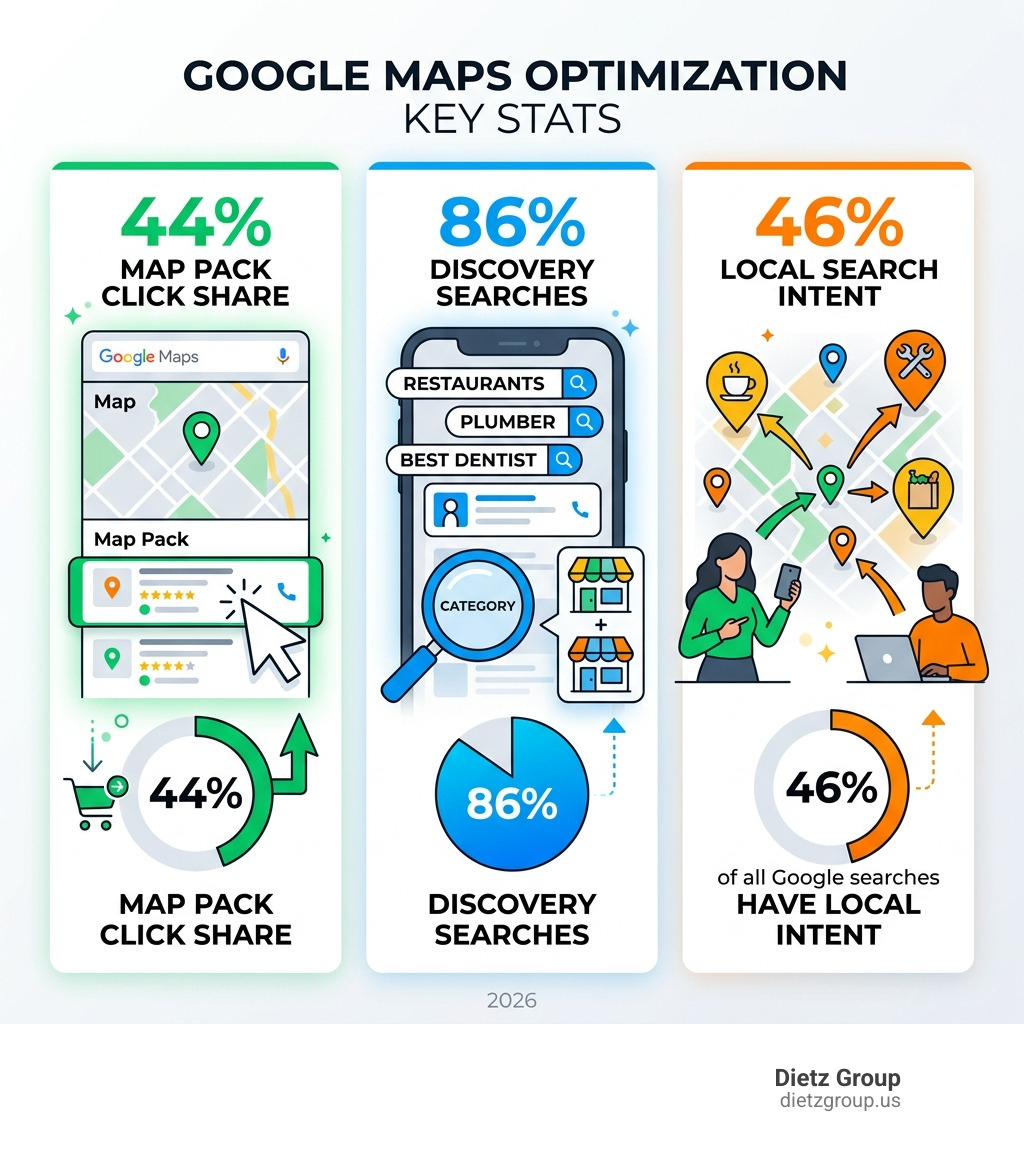
- 46% of all Google searches have local intent
- 86% of Google Business Profile views come from discovery searches — people searching for a category, not your business name
- The Map Pack captures 44% of all local search clicks
- 76% of people who search for a local business visit one within 24 hours
That means most of your potential customers are finding businesses like yours through category searches — not by already knowing your name. If you’re not showing up in the Map Pack, you’re invisible to the majority of high-intent local shoppers.
And this is especially true on mobile. Over 60% of local searches happen on a smartphone. Google Maps has 1.8 billion monthly active users. The stakes are high.
I’m Rob Dietz, a digital marketing consultant with over 18 years of experience helping local businesses grow online, including managing Google marketing campaigns since 2008 — and google maps optimization is one of the highest-ROI strategies I recommend to small business owners. Let’s walk through exactly how to do it right.
The Fundamentals of Google Maps Optimization
When we talk about google maps optimization, we are essentially trying to speak Google’s language. Google’s primary goal is to provide the user with the best possible answer to their query. If someone in Monroe, NC, searches for “HVAC repair,” Google wants to show the most reliable, closest, and most relevant business available.
To do this, Google evaluates three core pillars: Relevance, Distance, and Prominence.
- Relevance: How well does your business profile match what someone is searching for? This is why complete data is vital.
- Distance: How far is each potential search result from the location term used in a search? (If the user doesn’t specify a location, Google calculates distance based on what it knows about their location).
- Prominence: How well-known is the business? This is based on information Google has about a business from across the web, like links, articles, and directories.
Before you can even begin to rank, you must have a verified profile. Verification is the “handshake” between you and Google. It confirms you are who you say you are and that you actually operate at the stated location. While postcard verification was the standard for years, in 2026, we see a heavy shift toward video verification to combat spam.
For a deeper dive into the setup phase, check out our Ultimate Google Business Profile Management Guide. Once verified, you should also consider Google Maps Platform best practices: Optimization and performance tips – Google Maps Platform to ensure your technical integration is seamless.
Strategic Category Selection for Google Maps Optimization
Choosing your business categories is perhaps the most underrated part of google maps optimization. Your Primary Category carries roughly 70% of the ranking weight for category-related searches. If you get this wrong, you’re fighting an uphill battle.
We often see businesses choose a category that is too broad. For example, if you are an “EV Charging Station Installer,” don’t just settle for “Electrician.” Being specific tells Google exactly which high-intent searches you should appear for.
You can also select up to nine Secondary Categories. These help you show up for “discovery searches” (which account for 86% of all GBP views). If you’re a marketing agency, your secondary categories might include “Website Designer” or “Internet Marketing Service.” We discuss the nuances of this in our guide on Google Business Profile Management.
NAP Consistency and Citation Authority
NAP stands for Name, Address, and Phone number. In local SEO, consistency is king. If your business is listed as “Dietz Group” on your website but “The Dietz Group, LLC” on Yelp and “Dietz Marketing” on Facebook, Google gets confused.
When Google’s AI encounters conflicting data, it loses trust in your business’s location and legitimacy. This results in a lower “Grid Rank.” We recommend auditing your presence on the “Big Four” first: Google, Apple Maps, Bing, and Yelp. From there, you should expand to industry-specific directories.
In the modern landscape, especially as we head further into 2026, understanding What is NAP and Why It’s Critical for Local SEO in the Age of AI is essential. AI models use these citations as “fact-checking” points to verify your business’s existence.
Mastering the Three Pillars of Local Ranking
Since the “Vicinity” update, Google has placed a much heavier emphasis on Proximity. This means that even if you have a thousand 5-star reviews, a smaller shop that is 500 feet away from the searcher might outrank you. However, you can’t change your physical location (easily), so we focus our google maps optimization efforts on the factors we can control: Relevance and Prominence.
| Factor | What It Means | How to Optimize It |
|---|---|---|
| Relevance | Matching the query | Detailed descriptions, correct categories, and listing all services. |
| Distance | Proximity to searcher | Accurate address and service area settings. |
| Prominence | Authority and trust | Review volume, citations, backlinks, and active engagement. |
To master these, you need a long-term strategy. As we always tell our clients, a truly effective SEO campaign typically takes 12 to 18 months to see the full breadth of results. It’s a marathon, not a sprint. You can read more about this journey in The Roadmap to Success: Mastering Google Maps SEO for Local Growth.
Review Management as a Google Maps Optimization Catalyst
Reviews are the single most powerful ranking signal in the Map Pack. But it’s not just about the number of stars. Google looks at:
- Review Velocity: Are you getting reviews steadily, or did you get 50 in one day and then none for six months? Steady wins the race.
- Sentiment Analysis: Google’s AI reads the text of your reviews. If customers frequently use keywords like “best plumber in Monroe,” it boosts your relevance for those terms.
- Response Rate: Responding to reviews (both positive and negative) shows Google you are active. In fact, responding to reviews can trigger a subtle “verified” badge update in your dashboard within 24–48 hours.
- Review Diversity: By 2026, having reviews from various types of accounts and even in multiple languages (if applicable to your area) has become a stronger signal than raw count alone.
We also suggest using the chat feature to stay connected. Learn more about How to Talk to Your Customers with Google Business Profile Chat to improve your engagement signals.
Visual Content and Engagement Signals
A profile without photos is like a storefront with the lights off. Businesses that add photos to their profiles receive 42% more requests for directions on Google Maps.
We recommend uploading at least five new photos a week. These should include:
- Exterior shots: Help people (and Google’s Street View AI) recognize your building.
- Interior shots: Give customers a feel for the atmosphere.
- Team at work: Builds trust and authenticity.
- Geo-tagged photos: While Google strips some EXIF data, uploading photos taken at your place of business provides a subtle location signal.
Video is also becoming mandatory. However, many business owners face Challenges with Google Business Profile Video Verification. If you’re struggling with this, don’t give up—it’s a massive trust signal once cleared. For more quick wins, see these 3 Tips to Optimize Your Google Business Profile.
Technical Signals and Website Integration
Your website and your Google Maps listing are not two separate islands; they are an ecosystem. Google looks at your website to verify the information on your GBP.
One of the most critical technical elements is LocalBusiness Schema. This is a piece of code (JSON-LD) that tells search engines exactly what your business is, where it is, and what it offers in a structured format that AI can easily digest.
Furthermore, Core Web Vitals are now a direct ranking factor for local search. If your website takes forever to load on a mobile device, Google is less likely to recommend you in the Map Pack. Target a Largest Contentful Paint (LCP) of under 2.5 seconds. For a deep dive into these technical requirements, see the Optimization Guide | Google Maps Platform | Google for Developers.
If this sounds like a lot of “tech-speak,” don’t worry. Our Local SEO Services for Small Businesses are designed to handle the heavy lifting for you.
Hyperlocal Landing Pages and Schema Markup
If you serve multiple areas around Monroe, NC, you shouldn’t just have one “Contact” page. You need hyperlocal landing pages. These are pages dedicated to specific neighborhoods or suburbs.
Each page should include:
- Unique content about your services in that specific area.
- Mentions of local landmarks or community events.
- An embedded Google Map of your business location.
- Specific LocalBusiness Schema for that location.
This strategy helps you rank in areas further away from your physical “pin” on the map. As AI continues to change search, staying ahead with AI and Local SEO GBP strategies is the only way to maintain your lead.
Service-Area Business (SAB) Ranking Strategies
What if you don’t have a storefront? Many of our clients are plumbers, cleaners, or consultants who go to their customers. These are called Service-Area Businesses (SABs).
Common wisdom used to say you couldn’t rank well without a physical address shown on the map. However, we’ve found a contrarian truth: Hiding your address for an SAB can sometimes boost your rankings. It forces Google’s algorithm to weigh your “Service Area” settings more heavily than the exact proximity to a hidden pin.
When setting up your profile, make sure to toggle “I deliver goods and services to my customers” and set a realistic radius. If you’re just starting out, follow the steps in How Do I Get a Google Business Profile to ensure you set your service area correctly from day one.
Measuring Success and Troubleshooting Drops
You can’t manage what you don’t measure. In 2026, looking at your “Insights” tab in the GBP dashboard isn’t enough. Those numbers often have a 72-hour lag and don’t show you the “where.”
We use Grid Scans to track performance. A grid scan shows your ranking at various points in a geographic area (e.g., a 13×13 grid with points every 0.5 miles). This allows us to see exactly where your visibility drops off. If you are #1 at your front door but #10 two blocks away, we know we have a proximity/prominence gap to bridge.
If you see a sudden drop in rankings, it’s often due to a “Ghost Error” or a Google update. For instance, sometimes categories simply stop saving or show as “ineligible.” Often, clearing your browser cache or switching to a Chromium-based browser can fix these glitches. For more troubleshooting, check out our Google Business Profile Video Verification Tips.
Recovering from Suspensions and Ranking Shifts
A GBP suspension is a nightmare for any local business. It usually happens for one of three reasons:
- Keyword Stuffing: Adding words like “Best” or “Cheap” to your business name.
- Address Issues: Using a P.O. Box or a virtual office (Google is cracking down on these hard in 2026).
- NAP Mismatch: Major discrepancies in your data across the web.
If you get suspended, don’t panic and don’t create a new profile. That will only make it worse. You must go through the official appeal process, which often involves providing utility bills or business licenses to prove your location. We’ve covered the recovery process in detail in our Google Business Profile Webinar.
Frequently Asked Questions about Google Maps Optimization
How long does it take to see results from Google Maps optimization?
As mentioned earlier, we believe a solid SEO campaign takes 12 to 18 months to reach peak performance. While you might see “green arrows” in your direction requests within 30 to 90 days, true ranking stabilization in a competitive market takes time. Google needs to see consistent data and activity over a long period to fully trust your business as the “authority” in your area.
Can a business without a physical storefront rank in the Map Pack?
Absolutely. Service-Area Businesses (SABs) rank in the Map Pack every day. The key is to focus on hyperlocal content and review diversity. Because you don’t have a physical pin to anchor your proximity, Google relies more heavily on your service area settings and the “prominence” signals you send from across the web.
What are the most common mistakes that cause ranking drops?
The “Big Three” mistakes are keyword stuffing your business name, having duplicate listings, and failing to respond to reviews. Also, keep an eye on your website’s health. We once had a client lose their #1 spot simply because their website’s “Cumulative Layout Shift” (a Core Web Vital) spiked after a bad plugin update. Once we fixed the website, the Maps ranking returned.
Conclusion
Google Maps optimization is no longer an optional part of marketing; it is the foundation of local business growth. By focusing on relevance, distance, and prominence—and staying patient through the 12-18 month growth cycle—you can turn Google Maps into a consistent lead-generation machine.
At Dietz Group, we combine over 18 years of expertise with cutting-edge AI technology to help businesses like yours dominate the local search landscape. We focus on high-intent searches that drive real ROI, not just vanity metrics.
Ready to claim your spot at the top of the Map Pack? Explore our Google Business Profile Management Services and let’s start your route to success today.