Why Topic Clusters and Topical Authority Are the Future of SEO
Topic Clusters and Topical Authority are two connected strategies that help your website become the go-to source on a subject — so Google (and AI search tools) rank you higher, more often, and for more keywords.
Here’s the quick answer:
| Term | What It Means |
|---|---|
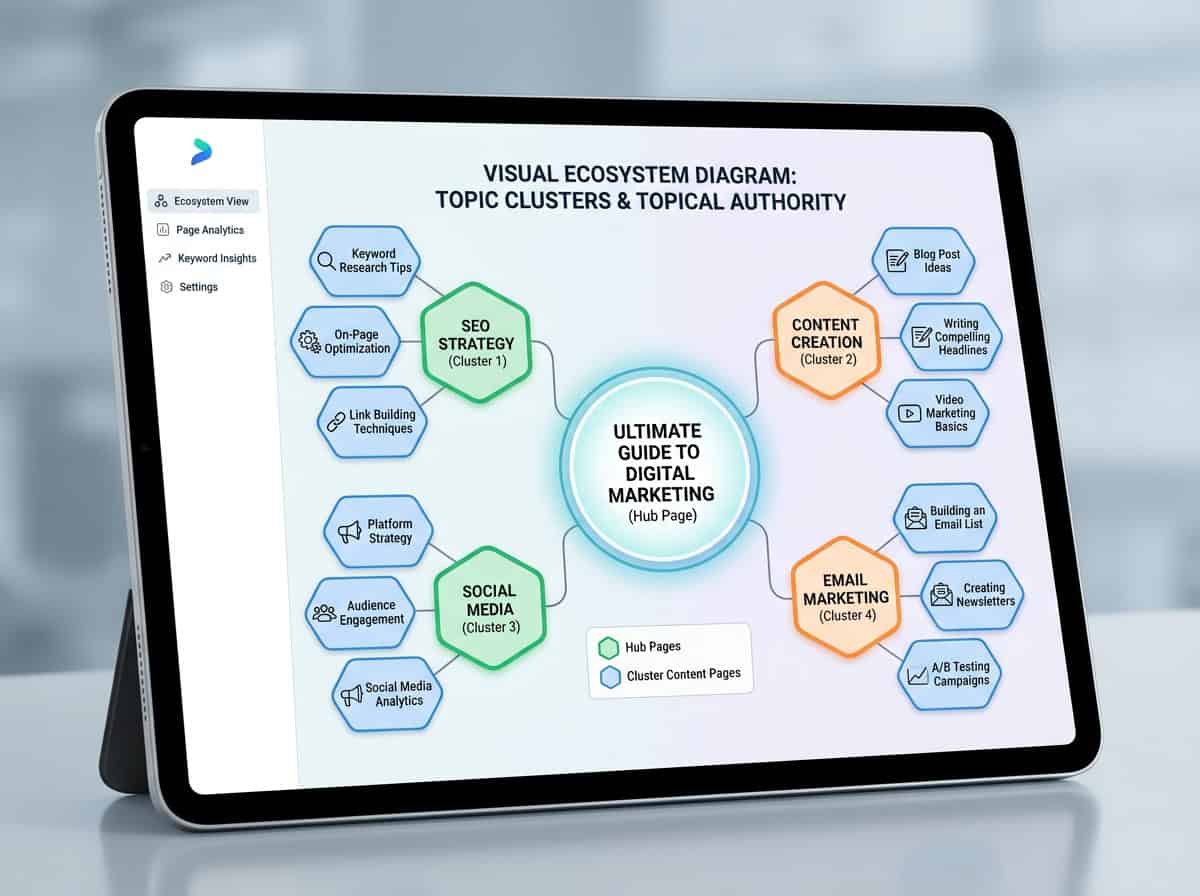
| Topic Cluster | A group of web pages — one main “pillar” page plus several supporting pages — all covering the same broad subject |
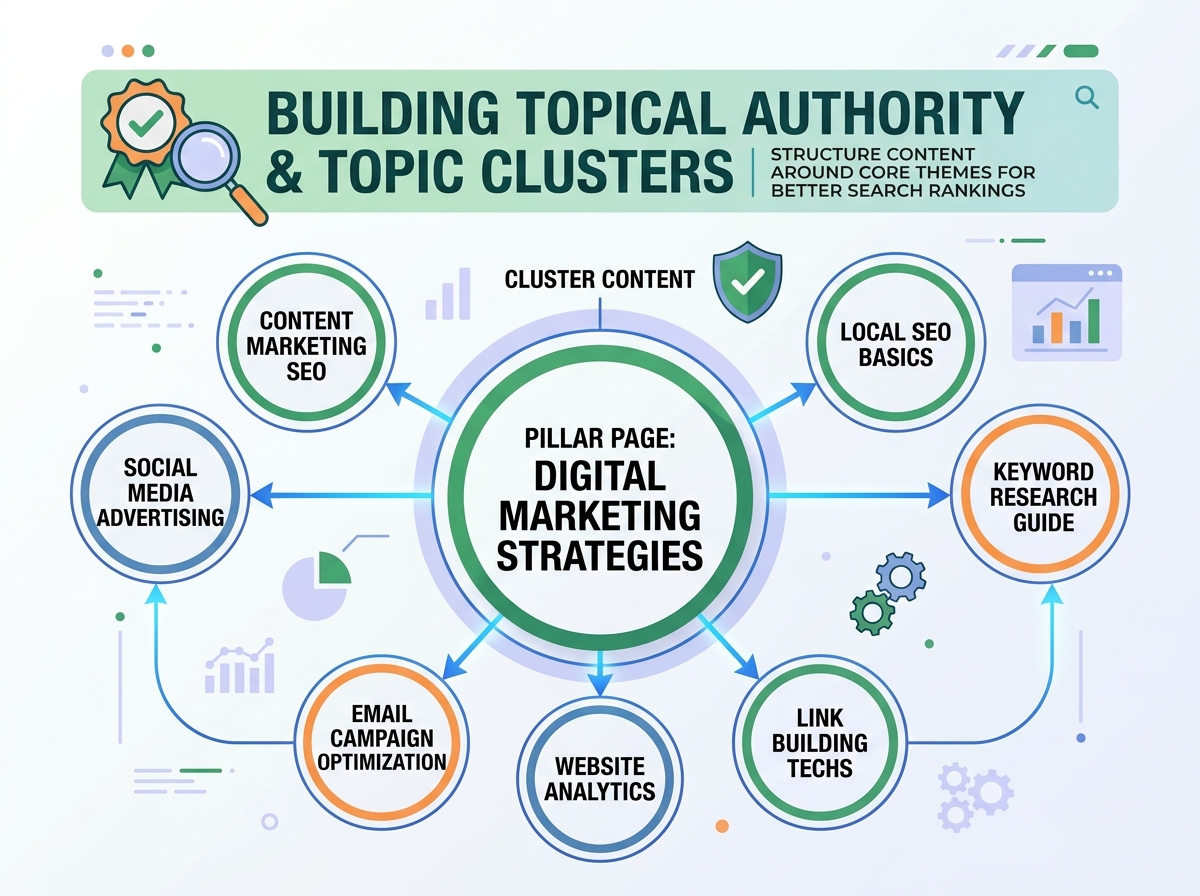
| Pillar Page | A comprehensive overview page on a core topic that links out to deeper subtopic pages |
| Cluster Pages | Focused supporting articles that each cover one subtopic in depth, linking back to the pillar |
| Topical Authority | How much Google and AI search trusts your site as an expert on a specific subject, based on how completely you cover it |
Why it matters in plain English:
- Instead of writing one article on “email marketing,” you build a hub of 10-20 connected articles covering every angle
- Google and AI tools see your site as an expert — not just a single page
- You rank for more keywords, attract more traffic, and hold those rankings longer
- Clustered content drives roughly 30% more organic traffic and holds rankings 2.5x longer than standalone pages
This is a shift away from the old “write one page per keyword” approach. Today, search engines and AI tools reward depth and breadth across a topic — not just keyword placement.
It doesn’t matter if you’re a small local business or a growing brand. If your website covers topics in isolated, disconnected articles, you’re leaving rankings — and customers — on the table.
The good news? You don’t need a massive content team or a huge budget. You need a clear strategy.
I’m Rob Dietz, a digital marketing consultant with over 18 years of experience helping businesses grow their online visibility. I’ve used Topic Clusters and Topical Authority as a core part of my SEO work since search engines began rewarding comprehensive content ecosystems over single-keyword pages. In the guide below, I’ll walk you through exactly how to build this strategy for your business.
Understanding Topic Clusters and Topical Authority
To understand why we prioritize Topic Clusters and Topical Authority, we have to look at how search engines have changed. In the early days, SEO was about matching a specific string of text. If someone searched for “red sneakers,” you just needed a page that said “red sneakers” more effectively than the next guy.
Today, Google uses sophisticated topic modeling to understand the meaning behind those words. As Search Engine Journal explains, search engines no longer rely solely on a relevant keyword; they use entities and concepts to determine what a user is truly looking for. This is the heart of What is Search Engine Optimization in the modern era: it is no longer about “tricking” an algorithm, but about demonstrating undeniable expertise.
The Shift from Keywords to Entities
The evolution of search has moved us from “strings” to “things.” An “entity” is a well-defined object or concept—like a person, place, or a specific service line. When we build content clusters, we aren’t just targeting keywords; we are mapping out an entire entity and its relationships.
What is the Purpose of Search Engine Optimization today? It is to satisfy search intent by providing contextual relevance. By covering a topic from every possible angle—answering the “who, what, where, and how”—we signal to search engines that our site is a semantically complete resource. This comprehensive approach ensures that when a user lands on our site, they don’t need to go back to the search results to find more information.
Why Topical Authority Outperforms Domain Authority
You might have noticed smaller, niche websites outranking massive global brands. This happens because comprehensive topic coverage can outperform higher-authority domains when content depth and internal relevance are stronger.
Domain Authority (DA) is a legacy metric based largely on backlinks. Topical Authority, however, is earned through content density. If we have 30 interlinked articles about “dental implants” and a major news site has only one, Google’s “ranking velocity” will often favor us. Why? Because our site demonstrates a higher level of E-E-A-T (Experience, Expertise, Authoritativeness, and Trustworthiness) specifically for that niche.
The Strategic Benefits of Content Clustering
Implementing Topic Clusters and Topical Authority isn’t just a “nice to have” SEO tactic; it’s a fundamental shift in site architecture that yields measurable business results.
The data is clear: clustered content drives 30% more traffic and holds rankings 2.5x longer than standalone pieces. Beyond just “more traffic,” clustering solves several technical and strategic headaches:
- Eliminating Keyword Cannibalization: When you have five random blog posts all trying to rank for the same broad term, they compete against each other. Clustering organizes them so each page has a unique job.
- Efficient Link Equity Distribution: When one page in your cluster gets a backlink, that “SEO juice” flows through your internal links to every other page in the group.
- Crawl Efficiency: Search engine bots can navigate your site more easily when related topics are linked together logically, ensuring your new content gets indexed faster.
If you’re wondering How Long Does SEO Take, the answer often depends on how well your content is structured. Clusters can speed up the process by proving your expertise to Google much faster than scattered posts ever could.
Improving User Engagement and Conversions
We don’t just build clusters for bots; we build them for people. A well-organized cluster maps to the buyer’s journey. A user might start at the “pillar” page for general information, then click through to a “cluster” page that solves a specific problem, and finally land on a service page to make a purchase.
This “information scent” keeps users on your site longer, reducing bounce rates and increasing the likelihood of a lead. When clients ask Is Paying for SEO Worth It, we point to the increased conversion rates that come from being a trusted, authoritative resource.
Dominating AI Overviews and Generative Search
The rise of AI search (GEO or Generative Engine Optimization) has made Topic Clusters and Topical Authority even more critical. Research shows that 86% of AI citations come from authoritative brand-managed sources—primarily structured, authoritative websites.
LLMs (Large Language Models) like ChatGPT and Google’s Gemini look for “entity saturation.” They want to cite sources that provide a complete answer. By building a semantic ecosystem, we make it nearly impossible for an AI to ignore our brand when it’s looking for the most expert response to a user’s query.
How to Build a Topic Cluster for Maximum Topical Authority
Building a cluster requires a move away from the “one-off” blog post mentality. It starts with a bird’s-eye view of your niche. If you are wondering How Do I Start with SEO, the first step is often a content audit to see what you already have and where the gaps are.
92% of all Google searches are long-tail keywords. These specific, high-intent phrases are the “spokes” that support your main “pillar.”
Step 1: Identifying Core Pillar Topics
Your pillar topic should be broad enough to spawn at least 10–20 subtopics but specific enough to be relevant to your business. For example, if you are a contractor, “Home Remodeling” is a great pillar. “How to pick a hammer” is too narrow.
When deciding Can I Do SEO on My Own, topic selection is where most people get stuck. We look for “problem-solving potential”—topics that your customers are actually asking about in their initial research phases.
Step 2: Mapping Subtopics and Entities
Once you have your pillar, you need to find your spokes. We use a variety of methods:
- People Also Ask (PAA): Look at the questions Google displays in search results. These are gold mines for cluster pages.
- Competitor Gaps: What are your competitors talking about that you’ve missed?
- Google Trends: See what’s rising in popularity right now to ensure your cluster is timely.
The goal is “semantic completeness.” You want to be the “Wikipedia” of your specific service line.
Step 3: Implementing Internal Linking for Topical Authority
Internal linking is the “glue” that holds your cluster together. It isn’t just about adding links; it’s about how you link. Pages with varied anchor text variations see higher traffic, so avoid using the exact same phrase every time.
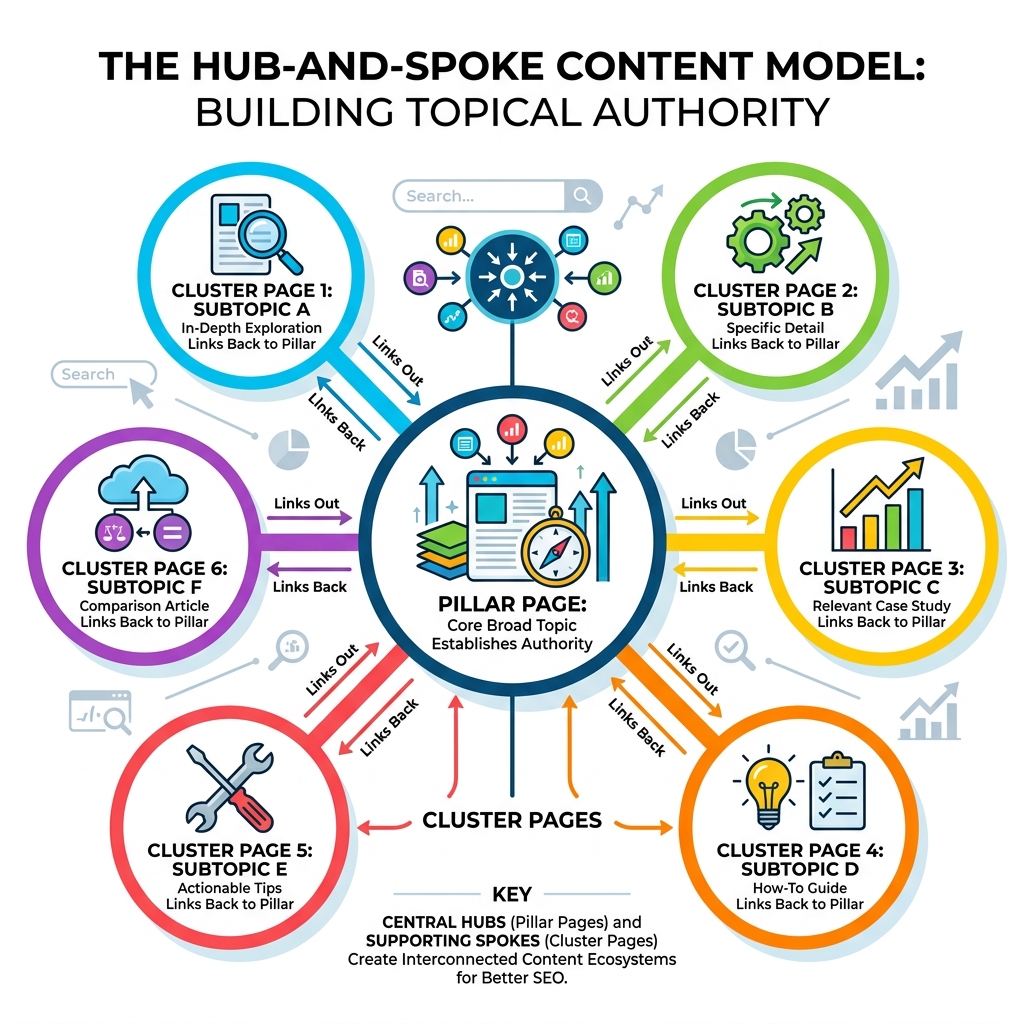
The rule is simple: Distribute link equity across your cluster by linking from the pillar to every spoke, and from every spoke back to the pillar. This creates a “hub-and-spoke” model that search engines can easily follow.
Advanced Optimization: Schema, GEO, and Technical SEO
To truly dominate, we have to look under the hood. Traditional SEO focuses on keywords, but advanced Topic Clusters and Topical Authority strategies focus on structured data.
| Feature | Traditional Keyword Targeting | Topic Clustering |
|---|---|---|
| Focus | Individual keywords | Broad topics & entities |
| Structure | Flat / Disconnected | Hierarchical / Linked |
| Goal | Rank one page | Own the entire SERP |
| Result | Temporary traffic spikes | Long-term authority |
What is Technical SEO and How Does it Help Your Website? It’s the framework that makes your content readable for machines. We use FAQ schema and Article schema to explicitly tell Google, “This page is an answer to this specific entity.” You can verify these connections using the Schema Markup Validator.
Scaling Clusters Across Multiple Service Lines
For a Local Search Engine Optimization Agency, scaling is about repeating the cluster success across every service you offer. If you’re a dentist in Monroe, NC, you don’t just want a cluster for “Invisalign”; you want one for “Preventative Care,” “Cosmetic Dentistry,” and “Emergency Services.”
Maintenance is key. We treat clusters as evergreen assets, updating them with new data and internal links as your business grows and search trends shift.
Measuring Cluster Performance and ROI
We don’t just look at “total traffic.” We use What is Google Search Console to track “keyword breadth.” Are we ranking for 100 keywords related to a topic or 1,000?
We also track “conversion lift.” A successful cluster should see a higher-than-average conversion rate because the users landing on those pages have been “educated” by your authoritative content before they ever see a “Contact Us” button.
Frequently Asked Questions about Topic Clusters
How many cluster pages do I need per pillar?
There is no “magic number,” but for most competitive niches, we recommend 10 to 20 cluster pages to achieve semantic completeness. The goal is to cover every reasonable question a user might have. If you’re in a very narrow niche, 5-8 might suffice; for broad industries like “Digital Marketing,” you could have 50+.
How do topic clusters prevent keyword cannibalization?
Clusters use “intent mapping.” Instead of having three pages that all vaguely talk about “SEO services,” we consolidate them. One page becomes the “What is” (Pillar), another becomes “Local SEO” (Spoke), and another becomes “Technical SEO” (Spoke). By giving each URL a specific job, we ensure they don’t compete for the same search results.
How long does it take to build topical authority?
SEO is a marathon, not a sprint. Typically, authority compounds over a 6-12 month window. You will see “ranking velocity” increase as you add more interlinked pages. The more consistently you publish high-quality “spokes,” the faster Google will trust your “pillar.”
Conclusion
At Dietz Group, we’ve seen how Topic Clusters and Topical Authority can transform a business’s online presence. It’s the difference between being a “blip” on the radar and being the undisputed leader in your local market.
Whether you’re wondering Will Local SEO Make a Difference for a Small Business or you’re ready to dive into AI-driven marketing, the foundation remains the same: provide the best, most comprehensive answers to your customers’ questions.
Ready to dominate your niche? Explore our Local SEO Services for Small Businesses and let’s start building your topical authority today.