Understanding GEO and ChatGPT SEO Best Practices
ChatGPT SEO best practices are the tactics you use to get your business cited and recommended inside AI-generated answers — not just ranked in a list of blue links.
Here are the core best practices at a glance:
- Allow AI crawlers (GPTBot, OAI-SearchBot) to access your site via robots.txt
- Structure content with clear headings, short paragraphs, and direct answers
- Write self-contained paragraphs so AI can extract them without context from surrounding text
- Use schema markup (FAQPage, HowTo, Article) to make content machine-readable
- Build authority signals through backlinks, reviews, and mentions on Reddit, G2, and Quora
- Increase fact density — use specific stats instead of vague claims
- Create answer-first content — lead every section with a 40–60 word direct response
- Keep content fresh — AI models prefer content that is regularly updated
Search is changing fast. In 2025, zero-click searches hit nearly 60% of all queries. Gartner predicts a 25% drop in traditional search volume by 2026. And AI-referred website sessions jumped 527% in just five months between January and May 2025.
That means fewer people are clicking links. More are getting answers directly from tools like ChatGPT, Perplexity, and Google’s AI Overviews.
For small business owners, this is a big deal. If your business isn’t being cited inside those AI answers, you’re invisible to a growing share of your potential customers — even if you rank well on Google today.
The good news? You don’t have to scrap your existing SEO. You build on it. The strategies that help you get cited by AI overlap heavily with what already makes good SEO — authority, clear content, and trust signals. You just need to apply them with AI systems in mind.
I’m Rob Dietz, a digital marketing consultant with over 18 years of experience helping businesses grow their online visibility. I’ve been applying ChatGPT SEO best practices alongside traditional SEO strategies to help clients stay ahead of major shifts in how search works — and this guide breaks down exactly what’s working right now.
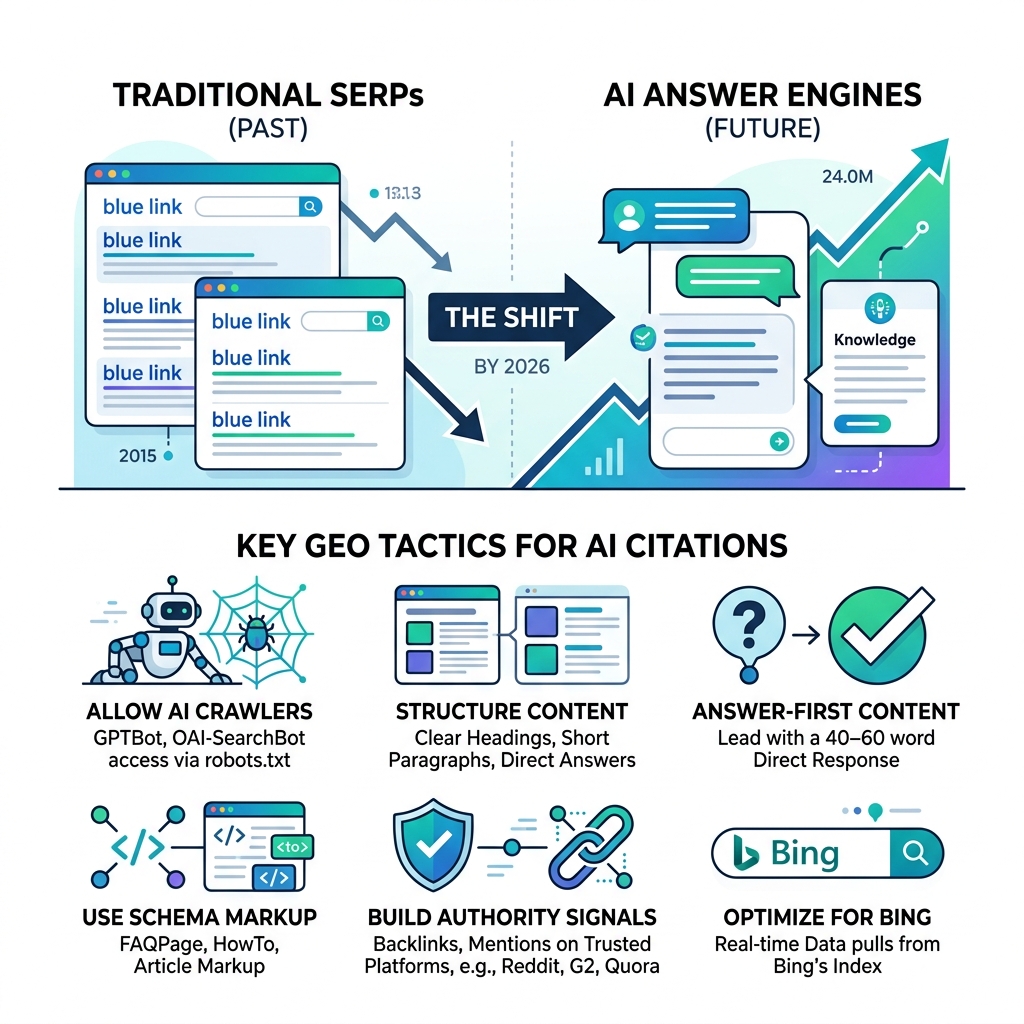
To win in 2026, we have to talk about Generative Engine Optimization (GEO). While traditional SEO is about moving your link from position #5 to position #1 on a search results page, GEO is about ensuring your brand is the “source of truth” that an AI model uses to build its answer.
Traditional SEO vs. GEO
In traditional search, Google acts as a librarian. You ask for a book on “local marketing in Monroe, NC,” and Google gives you a list of books. In the new “Reasoning Economy,” ChatGPT acts as a researcher. It reads all those books for you and gives you a three-paragraph summary of the best strategies.
If your website isn’t one of the “books” the researcher cites, you don’t exist in that conversation. What is Search Engine Optimization? has always been about visibility, but GEO shifts the focus from “clicks” to “citations.”
The formalization of this discipline is credited to researchers at Princeton University and Georgia Tech. Their seminal paper, “GEO: Generative Engine Optimization,” provided the first empirical evidence that specific content interventions can boost your visibility in AI responses by up to 40%.
Why Optimizing for ChatGPT SEO Best Practices is Critical for 2026
We are moving toward a world where “searching” is replaced by “answering.” Gartner predicts a 25% decline in traditional search volume by 2026, which means the pie is getting smaller for those who only rely on blue links.
Furthermore, we are preparing for the “Agentic Future.” The Agentic Future: Forrester forecasts that “Machine Customers” will autonomously negotiate purchases by 2028. Imagine an AI agent researching the best HVAC repair in Monroe, NC, comparing prices via API, and booking the appointment without the human ever visiting a website. To survive this, your data must be technically legible to machines, not just pretty for humans.
The Migration of Intent from Search to Chat
User behavior is shifting toward “ultra-long tail” queries. Instead of searching “SEO agency,” users are asking ChatGPT, “Find me a local SEO agency in Monroe, NC that specializes in high-ROI lead generation for small businesses and has 15+ years of experience.”
This migration of intent means that broad keywords are losing value, while specific, contextual content is gaining it. This is why The Rise of Generative AI SEO Services is becoming the standard for businesses that want to capture high-intent leads in a conversational search environment.
The Core Ranking Signals for AI Citations
How does ChatGPT decide who to trust? It doesn’t just pick at random. It looks for signals of authority and accuracy.
The Authority Trust Moat
AI models are inherently risk-averse. They don’t want to “hallucinate” or give bad advice. Because of this, they rely heavily on the link graph. Research shows sites with over 32,000 referring domains are 3.5x more likely to be cited by ChatGPT than lower-authority counterparts.
While that number sounds huge, it illustrates the “Trust Cliff.” For smaller businesses, this means you must lean into local authority and niche expertise. Is Paying for SEO Worth It? Absolutely, because building that “Trust Moat” is the only way to stay relevant when AI models are filtering for the most credible sources.
Fact Density and Statistical Freshness
One of the most powerful GEO tactics is “Fact Density.” The Princeton study found that including authoritative citations, statistics, and quotations can boost the visibility of lower-ranked websites by up to 40%. AI models love data. Instead of saying “We have a lot of experience,” say “We have 18+ years of expertise and have managed over 500 local campaigns.”
Freshness also matters. AI-cited content is often 25.7% fresher than traditional organic results. If your stats are from 2021, ChatGPT will likely pass you over for a competitor with 2025 data.
Building Trust through Consensus and Authority
AI models use “Consensus” to minimize errors. If your brand is mentioned positively on Reddit, Quora, and G2, the AI sees a pattern of trust. High mention volume on these platforms correlates with a 4x increase in citations.
We call this “Co-citation Neighborhoods.” If your business is frequently mentioned alongside other industry leaders, the AI begins to associate you with that same level of authority. What is the Purpose of Search Engine Optimization? In 2026, it’s about building a digital footprint that screams “trust” across the entire web, not just on your own domain.
Content-Answer Fit and the Island Test
To be cited, your content must pass the “Island Test.” This means every paragraph should be self-contained. If an AI “chunks” your content into a vector (a mathematical representation of the text), that chunk must make sense on its own.
Avoid using pronouns like “it” or “they” at the start of paragraphs if the subject was defined three paragraphs ago. Instead of saying “It is the best way to grow,” say “Generative Engine Optimization is the best way to grow.” This increases your “Content-Answer Fit” and makes it easy for the AI to extract your information for a response. How Do I Start with SEO? Start by auditing your existing content for these “islands” of information.
Content Engineering: Writing for Humans and Machines
In the past, we wrote for humans and optimized for keywords. Today, we must write for humans and structure for machines.
| Feature | Human UX (User Experience) | Machine Legibility (GEO) |
|---|---|---|
| Tone | Engaging, Story-driven | Objective, “Wiki-Voice” |
| Structure | Visual flow, Catchy headers | H1-H3 hierarchy, Schema |
| Length | Varied for engagement | 120-180 word focused sections |
| Data | Infographics, Charts | Tables, Lists, JSON-LD |
Implementing ChatGPT SEO Best Practices in Content Structure
We recommend using the Inverted Pyramid style. Start with the most important information (the answer), followed by supporting details, and then background info.
- Answer Blocks: Lead every H2 section with a 40–60 word direct answer. This is “answer readiness.”
- Section Length: Sections of 120–180 words perform best for AI extraction.
- Wiki-Voice: Write in a neutral, authoritative tone. Avoid “salesy” language like “the best ever” or “unbeatable.” AI models prefer objective prose.
What is Technical SEO and How Does it Help Your Website? It provides the skeleton that allows these content blocks to be discovered. Without technical health, your “Wiki-Voice” content is just a tree falling in an empty forest.
Leveraging Multi-Modal Content for Dwell Time
While ChatGPT is a text-heavy interface, the search results it pulls from (like Bing) prioritize engagement. Use AI-generated visuals, infographics, and video summaries to keep users on the page.
If a user clicks through from an AI answer and immediately bounces because your page is a wall of text, the AI learns that your site isn’t a good recommendation. Local Search Engine Optimization Agency services now include optimizing these multi-modal elements to ensure that once you get the click, you keep the customer.
Technical SEO for the Agentic Future
Technical SEO isn’t just about page speed anymore; it’s about “computational legibility.”
Schema Markup: The GEO Cheat Code
Schema markup acts as a translator for AI. Brands using full schema implementation saw 37% more citations in AI-generated answers and 24% faster re-inclusion after core updates.
At a minimum, you should implement:
- FAQPage Schema: Directly feeds the “Answer Engine.”
- Article Schema: Includes
dateModifiedto prove your content is fresh. - Organization Schema: Defines your “Entity” so the AI knows exactly who you are.
Crawlability and AI Bots
Should you block AI crawlers? Generally, no. Blocking GPTBot or OAI-SearchBot is like telling a librarian they aren’t allowed to read your book. If you aren’t in the model’s “memory,” you won’t be in the model’s “answers.”
However, you must ensure your site uses Server-Side Rendering (SSR). AI crawlers have limited ability to execute heavy JavaScript. If your content only loads after a bunch of scripts run, the AI might see a blank page. For more on this, check out How OpenAI Crawls and Indexes Your Website.
The llms.txt Standard
An emerging best practice is creating an
/ai
directory or an
llms.txt
file. This is a plain-text file that provides a summary of your site’s most important information, specifically formatted for Large Language Models to read quickly. It’s like a robots.txt file, but for intelligence rather than just indexing.
Measuring Success with Share of Model (SoM)
How do you know if your ChatGPT SEO best practices are working? You can’t just look at Google Search Console anymore.
We use a metric called Share of Model (SoM). This measures how often your brand is cited when an AI is asked a relevant question.
- Manual Testing: Ask ChatGPT “Who are the best SEO experts in Monroe, NC?” and see if we appear.
- Sentiment Analysis: Is the AI recommending you warmly, or just listing you as an option?
- AI-Referred Traffic: Monitor your analytics for referrals from
chatgpt.com,perplexity.ai, oropenai.com.
Visitors coming through LLM-generated answers are worth 4.4x more than traditional organic visitors because they have been “pre-sold” by the AI’s recommendation. How Long Does SEO Take? In the AI world, you can see citation jumps much faster than traditional rank increases if you nail the “Fact Density” and “Answer Blocks.”
Conclusion
The digital landscape is facing its most significant structural realignment in twenty years. At Dietz Group, we don’t just react to these changes — we lead them. By combining 18+ years of SEO expertise with cutting-edge GEO tactics, we help businesses in Monroe, NC, and beyond dominate the “Reasoning Economy.”
Future-proofing your business means being visible where your customers are asking questions. Whether that’s a traditional Google search or a deep-research session with ChatGPT, our high-ROI strategies ensure you are the answer they find.
Ready to claim your share of the AI search market? Explore our Local Generative Engine Optimization Agency services and let’s build your trust moat together.
What is the difference between SEO and GEO?
Traditional SEO focuses on Retrieval — ranking links in a list based on keywords. GEO focuses on Synthesis — being included in the AI’s generated summary. While SEO cares about “Position 1,” GEO cares about “Citation 1.” SEO uses keywords; GEO uses fact density and semantic structure.
Should I block AI crawlers like GPTBot?
For 99% of businesses, the answer is no. Blocking these bots removes your site from the AI’s long-term memory. If you block them, you won’t be cited in answers, and you’ll miss out on the high-value traffic that AI recommendations provide. Only block them if you have proprietary data that you don’t want used for model training.
How do I measure AI citation performance?
The primary metric is Share of Model (SoM). You can track this by prompting various LLMs with your core “money queries” and documenting how often your brand appears. Additionally, watch for referral traffic from AI domains and use tools that monitor brand sentiment within AI-generated responses.