Is Your Google Business Profile Actually Working for You?
A google business profile audit is a structured review of your listing on Google Search and Maps — checking that every element is complete, accurate, and optimized to help local customers find and choose you.
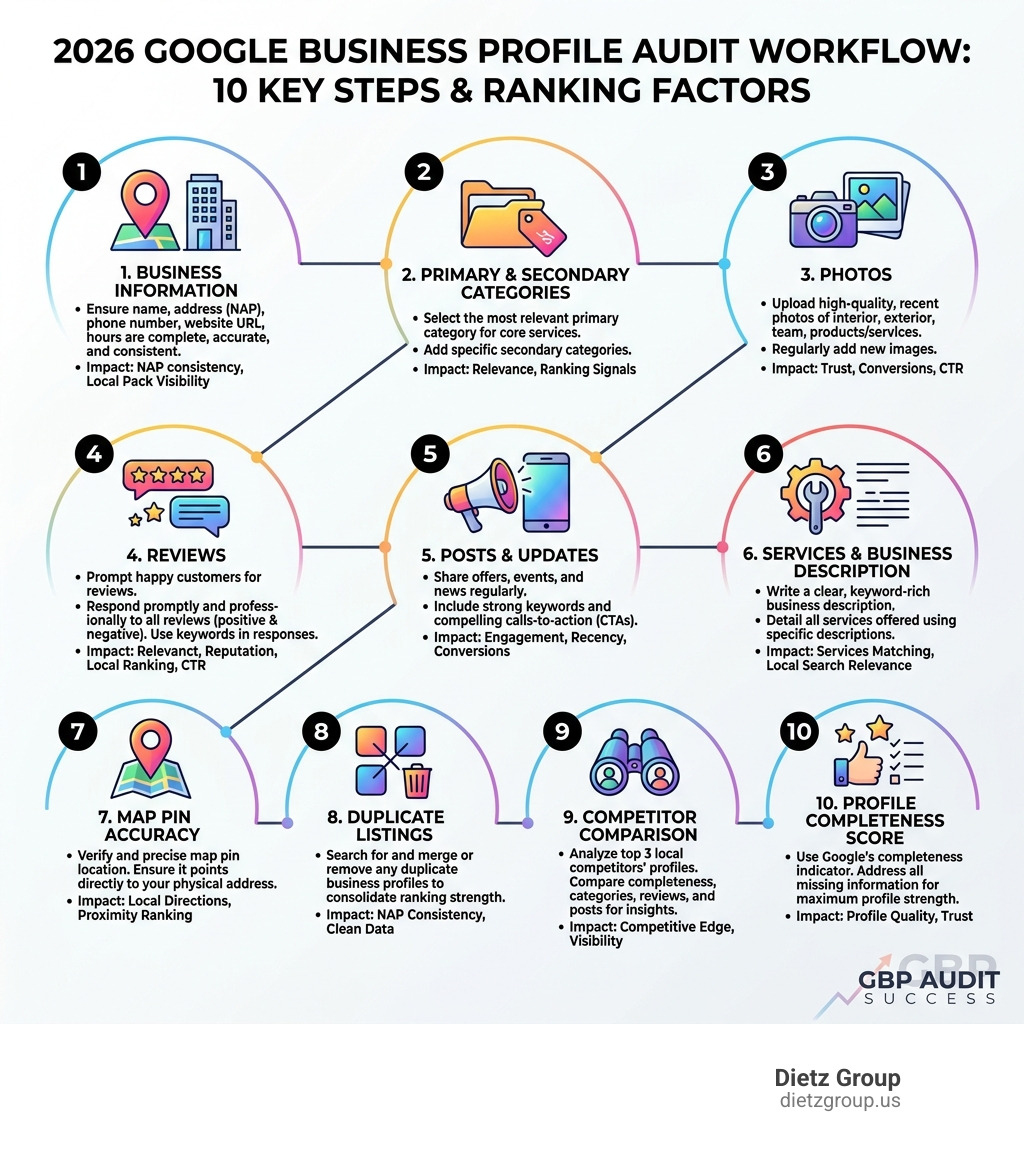
Here’s what a GBP audit covers at a glance:
- Business information — Name, address, phone number, website URL, and hours
- Primary and secondary categories — Are they the right fit for your core services?
- Photos — Enough of them, recent enough, and the right types
- Reviews — Response rate, recency, and overall rating
- Posts and updates — Active, keyword-rich, and posted consistently
- Services and business description — Complete, specific, and written for customers
- Map pin accuracy — Is it placed on your actual building?
- Duplicate listings — Any conflicting profiles splitting your ranking signals?
- Competitor comparison — How does your profile stack up against the top 3?
- Profile completeness score — Any missing fields holding you back?
Think of your Google Business Profile as your real homepage. For many small businesses, it’s the first — and sometimes only — thing a potential customer sees before deciding to call, visit, or move on to a competitor.
Here’s the problem: most profiles are set up once and forgotten. Hours go stale. Photos get outdated. Reviews pile up unanswered. Categories get chosen at random. Meanwhile, a competitor down the street quietly optimizes their profile and starts showing up where you used to.
According to available data, businesses with complete profiles are 2.7x more likely to be considered reputable by potential customers. And GBP signals account for roughly 32% of local pack ranking factors — meaning your profile isn’t just a nice-to-have. It directly affects whether you show up at all.
I’m Rob Dietz, and I’ve been helping businesses improve their local search visibility since 2008 — long before Google Business Profile had its current name. Over the years, a google business profile audit has become one of the first things I do when a new client wants more calls, more foot traffic, and more leads from local search.
Why a Google Business Profile Audit is Non-Negotiable in 2026
In the current landscape of May 2026, your presence in the “Local Pack” (those top three map results) is the lifeblood of local lead generation. A google business profile audit is no longer a “one-and-done” task; it is a vital part of maintaining your conversion assets. With the rise of zero-click searches—where users get all the info they need without ever clicking through to your website—your profile must do the heavy lifting.
Furthermore, Google’s AI Overviews now heavily rely on the data within your profile to recommend businesses. If your services section is empty or your attributes are missing, you are essentially invisible to AI-driven search summaries. By performing an Audit Your Google Business Profile, you ensure that your data is structured in a way that Google trusts. For a deeper dive into how this fits into your broader strategy, check out our more info about Google Business Profile Management.
Frequency and Impact of Regular Audits
We recommend a two-tiered approach to auditing. First, conduct a comprehensive google business profile audit every quarter. This helps catch “data drift”—where Google might have automatically updated your info based on third-party sources or user suggestions that aren’t quite right. Second, perform monthly spot checks on your hours, recent photos, and review responses.
Regularly auditing your profile provides a massive competitive advantage. While your competitors are “phoning it in,” you are signaling to Google that your business is active and reliable. For those interested in the technical side, there is significant scientific research on Google Business Profile Management & Optimization that proves consistent updates lead to higher visibility and user engagement.
How to Execute a Comprehensive Google Business Profile Audit
When we sit down to perform an audit, we prioritize fixes based on their impact on your rankings and conversions. Not all tasks are created equal. Some are “Critical” because they prevent you from ranking at all, while others are “Optimization” tasks that help you convert the traffic you already have.
| Priority | Audit Element | Why It Matters |
|---|---|---|
| Critical | NAP Consistency | Conflicting data confuses Google and kills trust. |
| Critical | Primary Category | This is the #1 mover for Local Pack rankings. |
| High | Review Response | Signals to Google and customers that you are active. |
| High | Service Descriptions | Essential for AI Overview eligibility in 2026. |
| Medium | Attributes | Helps with specific searches (e.g., “wheelchair accessible”). |
| Medium | Post Frequency | Shows your profile is “alive” and updated. |
To see how these elements fit into a broader management strategy, read our Ultimate Google Business Profile Management Guide.
Verifying NAP Consistency and Core Information
NAP stands for Name, Address, and Phone Number. In a google business profile audit, this is the foundation. Your business name should match your legal name exactly—don’t try to “keyword stuff” by adding your city or service to the name if it’s not legally there. Google’s 2026 algorithm is particularly aggressive about flagging and suspending profiles that use fake names.
Address formatting also matters. “123 Main St” vs. “123 Main Street” might seem small to you, but consistency across the web helps Google’s crawlers verify your location. Always use a local phone number rather than a toll-free one to emphasize your local roots. Finally, ensure your website URL leads to a high-quality, mobile-friendly page. If you’re still wondering what is a Google Business Profile?, it’s time to get back to basics.
Selecting the Right Primary Category for Your Google Business Profile Audit
The primary category is arguably the most important relevance field in your entire profile. It tells Google exactly what you do. If you are a plumber who also does HVAC, but 80% of your revenue comes from plumbing, your primary category should be “Plumber” or “Plumbing Contractor.”
Don’t just choose the broadest category. Be specific. If you’re an Italian restaurant, choose “Italian Restaurant” rather than just “Restaurant.” You can add up to nine secondary categories to cover your other services, but that primary choice is what moves the needle for the Local Pack. If you’re just starting out, we have a guide on how do I get a Google Business Profile? to help you set that foundation.
Analyzing Visual Content and Review Velocity

Photos are not just for show; they are ranking signals. Research shows that businesses with photos receive 42% more direction requests and 35% more website clicks. Even more striking, businesses with over 100 photos see a 520% increase in calls compared to those with fewer images.
During your google business profile audit, check your photo count and variety. You should have:
- High-resolution logos and cover photos.
- Exterior shots (to help people find you).
- Interior shots (to show your atmosphere).
- Team photos (to build trust).
- Product or service-in-action shots.
For more tips, check out our 3 tips to optimize your Google Business Profile.
Maximizing Engagement with Photos and Posts
In 2026, Google’s AI systems are actually “reading” the content of your photos to connect your profile to specific search intents. We recommend a weekly cadence of uploading 2 to 5 new photos. This signals “vitality” to Google.
Similarly, Google Posts (Updates) should be published at least once a week. These posts are your chance to share offers, news, or helpful tips. Always include a clear Call to Action (CTA) like “Call Now” or “Book Online.” While you’re at it, make sure your messaging is turned on so you can talk to your customers with Google Business Profile Chat.
Advanced Competitor Benchmarking and AI Visibility

A google business profile audit isn’t complete without looking at the “neighborhood.” Who is currently in the top 3 for your target keywords? Use tools to “spy” on their categories—are they using a primary category you missed?
In 2026, we also look at LLM (Large Language Model) visibility. Is your business being recommended by ChatGPT, Gemini, or Claude when someone asks for a local service? This “Generative Engine Optimization” (GEO) is the new frontier of local search. Completing every section of your profile, especially the services and descriptions, makes you more likely to be picked up by these AI models. You can learn more about this through Stvnsn Digital | Local SEO & Google Maps Growth.
Tracking Performance During Your Google Business Profile Audit
SEO is a marathon, not a sprint. We always tell our clients that a solid SEO campaign takes 12 to 18 months to see full, sustainable results. During your audit, look at your “Performance” tab in Google.
Don’t just look at impressions; look at your action rate. If 2,000 people saw your profile but only 10 called, there is a conversion gap. Are your photos bad? Is your description unclear? Tracking these metrics monthly allows you to pivot your strategy. For professional help with this data, explore our Google Business Profile Management Services.
Step-by-Step Instructions for a Complete Manual Audit
If you want to run a manual google business profile audit today, follow this 10-step checklist:
- Verify Ownership: Ensure only current, trusted employees have access.
- Check Name Accuracy: Match your legal name exactly.
- Validate Address & Map Pin: Use satellite view to make sure the pin is on your building, not the street.
- Audit Hours: Ensure regular and holiday hours are 100% accurate.
- Review Categories: Verify your primary category is your highest-revenue service.
- Analyze Photos: Aim for at least 30-50 high-quality, non-stock images.
- Read & Respond to Reviews: Reply to every single review (yes, even the bad ones) within 48 hours.
- Audit Services/Products: Fill out descriptions for every service you offer.
- Check Business Description: Use all 750 characters to explain what you do, where you are, and why you’re better.
- Remove Duplicates: Search for your business name and address to ensure no “ghost” profiles are stealing your authority.
For those in the verification phase, don’t miss our Google Business Profile Video Verification Tips.
Avoiding Common Mistakes and Suspensions
The quickest way to ruin your local SEO is to get suspended. Common triggers include using P.O. Boxes or virtual offices (which have a 60% rejection rate in 2026), keyword stuffing your business name, or having multiple listings for the same location.
Google’s verification process has become much more rigorous. If you’re struggling, read up on the challenges with Google Business Profile Video Verification to avoid common pitfalls.
Frequently Asked Questions about GBP Audits
How often should I run a Google Business Profile audit?
We recommend a deep-dive audit every quarter and a quick “sniff test” once a month. This ensures your hours stay updated and you stay ahead of competitor changes.
What is the most important part of a Google Business Profile?
The primary category is the most important factor for ranking, while high-quality photos and recent reviews are the most important factors for converting a searcher into a customer.
Can a complete profile guarantee a #1 ranking?
No. A complete profile is the foundation, but rankings are also determined by proximity (how close you are to the searcher) and prominence (your overall online authority and review count).
Conclusion
A google business profile audit is the fastest way to find and fix the “leaks” in your local marketing funnel. In 2026, where AI and zero-click searches dominate, your profile is often the only chance you get to make a first impression. At Dietz Group, we combine 18+ years of expertise with cutting-edge AI technology to ensure our clients don’t just show up—they dominate.
Ready to stop slacking and start growing? Watch our Google Business Profile Webinar for more expert insights, or Claim Your Local Search Boost today to see how we can turn your profile into a lead-generating machine.