Why Local Search Visibility Matters for Your Business in 2026
If you want to boost local search visibility, here are the most effective steps you can take right now:
- Optimize your Google Business Profile — complete every field, add photos, and post regular updates
- Keep your NAP consistent — same business name, address, and phone number across every directory
- Earn and respond to reviews — volume, recency, and your responses all influence rankings
- Build local citations — get listed on authoritative directories like Yelp, Apple Maps, and the BBB
- Create location-specific content — use geo-targeted keywords on your website and service pages
- Add LocalBusiness schema markup — help search engines and AI tools understand your business
- Optimize for AI search engines — structure content so ChatGPT, Gemini, and Perplexity can recommend you
Nearly half of all Google searches have local intent. That means right now, people in your area are searching for exactly what you offer — and if your business isn’t showing up, a competitor is getting that call instead.
The stakes are real. 76% of people who do a “near me” search visit a business within 24 hours. That’s not a casual browser. That’s a buyer.
But local search has changed. It’s no longer just about ranking in Google Maps. AI-powered answer engines like ChatGPT, Gemini, and Perplexity are now recommending local businesses directly inside their responses — without the user ever clicking a traditional search result. If your business isn’t structured to show up in those answers, you’re leaving a growing share of potential customers on the table.
The good news? Most small businesses haven’t adapted yet. That means the opportunity to get ahead is still wide open.
I’m Rob Dietz, and I’ve been helping local businesses grow their digital presence since 2008. Over the past 18+ years, I’ve seen every shift in local search — from early Google Maps to today’s AI-driven answer engines — and I’ve developed proven strategies to boost local search visibility for businesses across competitive markets. In this guide, I’ll walk you through exactly what works in 2026.
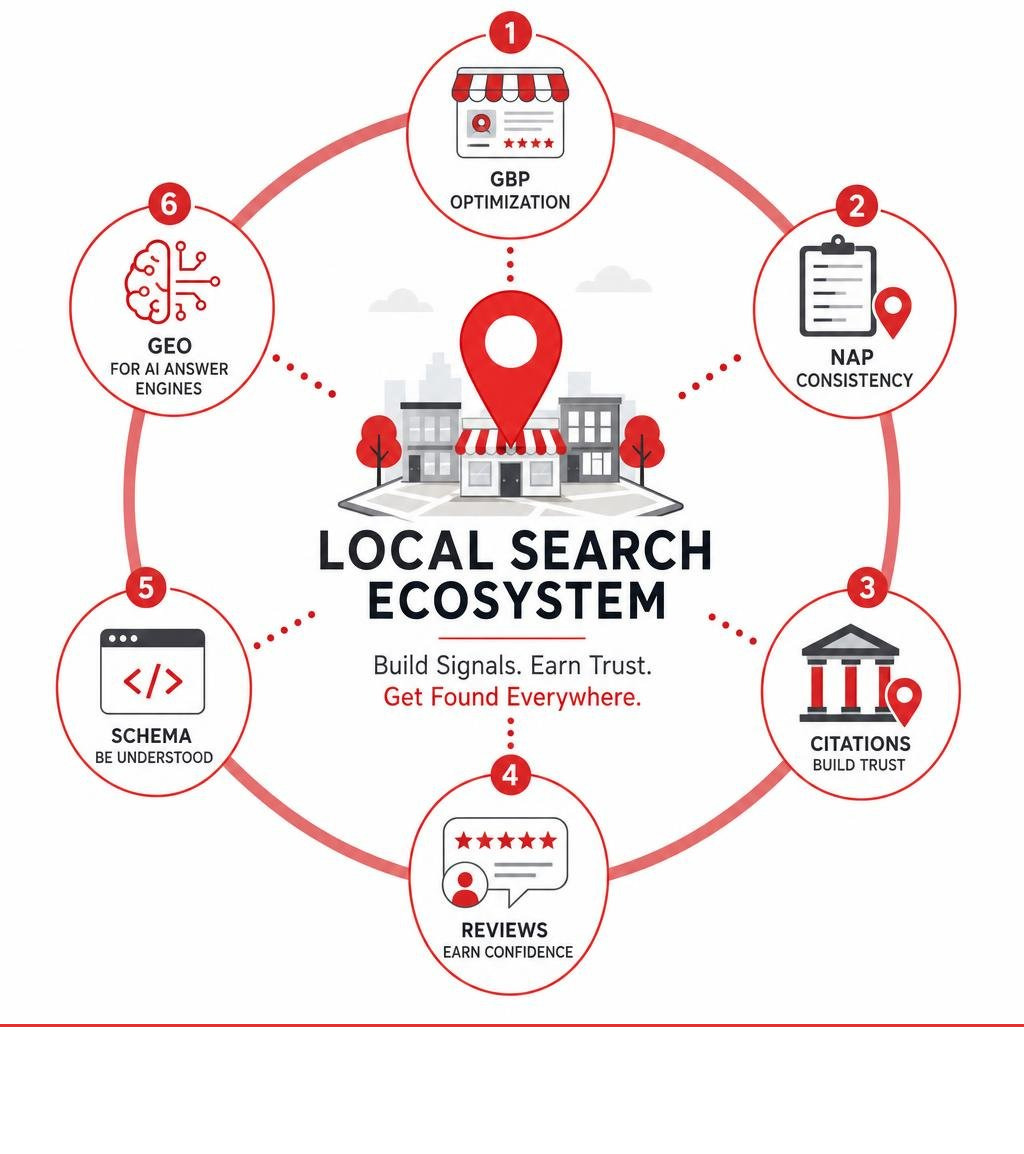
Boost local search visibility terms at a glance:
Core Pillars to Boost Local Search Visibility in 2026
To understand how to dominate local search, we first have to understand how search engines evaluate your business. Google relies on three core pillars to determine local rankings: relevance, distance, and prominence.
- Relevance: How well does your business match what the user is searching for?
- Distance: How far is your physical location or service area from the searcher?
- Prominence: How well-known, trusted, and authoritative is your business online?

While you cannot change a user’s physical location (distance), you have total control over your relevance and prominence. By demonstrating unmatched local authority, we help you signal to search engines that your business is the absolute best answer to a user’s query.
Investing in these signals yields incredible returns. When you align your digital presence with what search algorithms and human users look for, you build a sustainable source of inbound leads. If you are wondering whether this level of optimization is worth the effort, explore our analysis on Will Local SEO Make a Difference for a Small Business? to see how local search transforms bottom-line revenue.
Optimizing Your Google Business Profile for Maximum Reach
Your Google Business Profile (GBP) is the absolute foundation of your local presence. It is the first touchpoint for customers searching on Google Maps and traditional search. To maximize your reach, aiming for a 95%+ profile completeness score is essential.
First, select your primary category with extreme care. It must accurately reflect your core business model. If you are a residential plumber, do not select a generic category like “contractor” as your primary option; choose “plumber.” You can then add up to nine secondary categories to cover your other services.
Next, write a compelling business description of up to 750 characters. Focus on who you are, what you do, your unique value proposition, and the specific areas you serve. Avoid stuffed keywords; instead, write naturally for human readers.
Visuals are equally critical. Listings with high-quality, real photos receive significantly more clicks, calls, and direction requests than those with stale stock images or empty profiles. We recommend uploading fresh, high-resolution photos of your team, your physical storefront, and your completed projects on a monthly basis. This continuous activity signals to Google that your business is active and engaged. For a deeper dive into these techniques, read our Ultimate Guide to Google Business Profile Optimization and discover advanced growth strategies with our Killer GBP Growth Tactics for Dominating Local Search.
Maintaining NAP Consistency Across Directories
NAP stands for Name, Address, and Phone number. For search engines to trust your business as a real, credible entity, this information must be identical across every single directory, social platform, and website where your brand is mentioned.
Inconsistencies confuse search algorithms. If one directory lists your business as “Main Street Auto, LLC” at “123 Main St. Suite B” and another lists you as “Main Street Automotive” at “123 Main Street,” search engines may treat these as two separate, low-authority entities. This dilutes your prominence score and hurts your rankings.
Building consistent citations across major directories—such as Apple Maps, Yelp, the Better Business Bureau (BBB), and local chambers of commerce—creates a cohesive digital footprint. To learn more about setting up this infrastructure, check out How to Boost Local Search Visibility and Drive More Traffic for a practical look at listing management.
On-Page, Off-Page, and AI-Driven SEO Tactics
To truly stand out in 2026, you cannot rely solely on your Google Business Profile. You must connect your profile to a highly optimized website that acts as an authority hub for your local market.
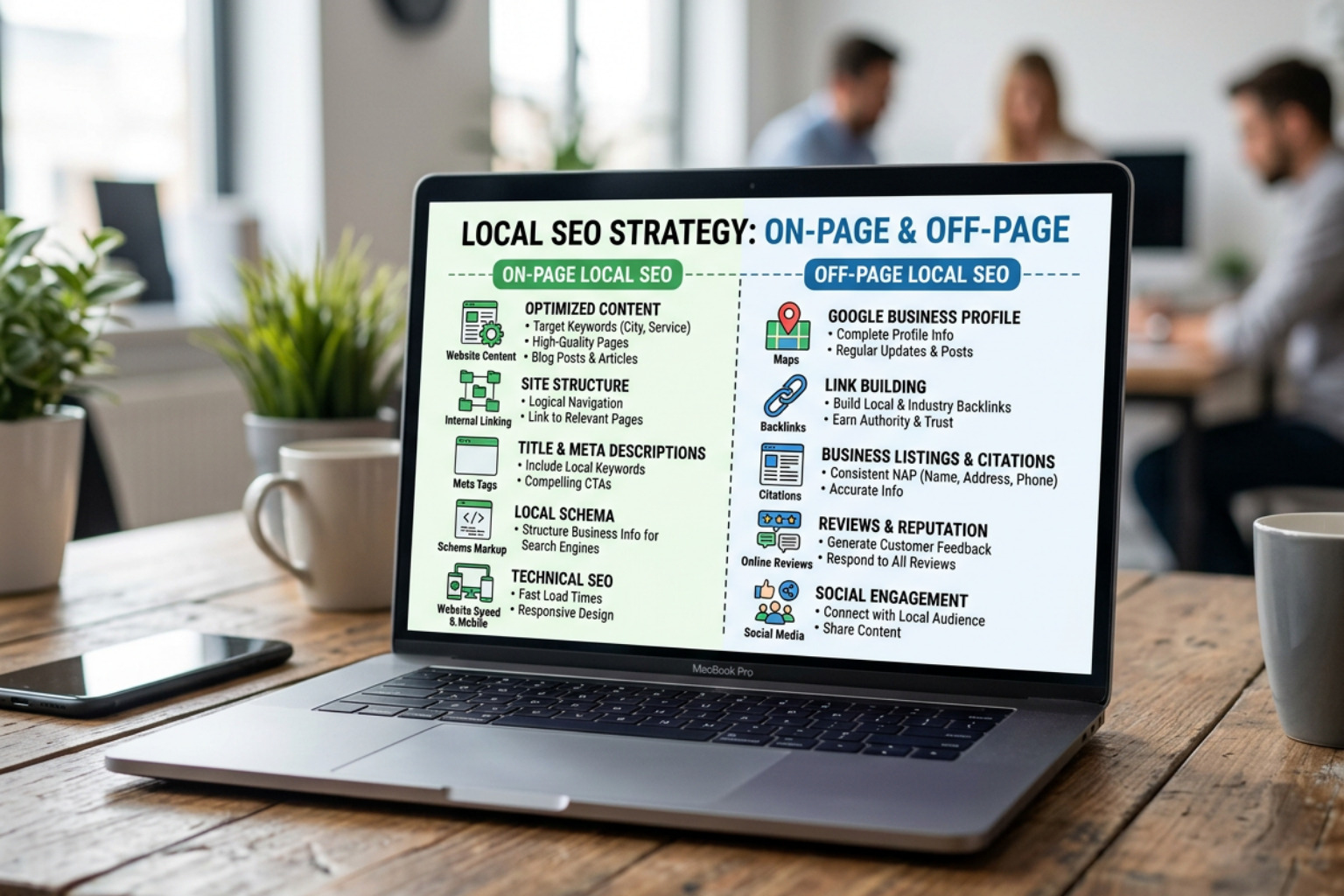
A comprehensive local strategy combines on-page content, technical data structures, and off-page relationship building. Together, these signals prove to search engines and AI assistants that you are a trusted community staple. To explore how we build these custom strategies for businesses, view our dedicated Local SEO Services for Small Businesses.
On-Page Content Strategies to Boost Local Search Visibility
Your website’s content needs to speak the language of your local community. Rather than targeting broad, national terms, we focus on geo-targeted keywords that match the exact search intent of nearby buyers.
If your business serves multiple neighborhoods or cities, creating dedicated, high-quality location pages is a must. These pages should not be duplicate carbon copies with the city name swapped out. To avoid search engine penalties, each page must provide unique, valuable local information, such as:
- Local customer testimonials and project showcases
- Staff bios of team members serving that specific area
- Specific driving directions or neighborhood landmarks
- Localized FAQs addressing regional pain points
Using natural, conversational phrasing helps capture high-intent “near me” searches. For a step-by-step framework on mapping out these terms, read our guide on Where in the World: A Guide to Geo-Specific Keyword Targeting and learn how to capture immediate local demand with our Ultimate Guide to Local SEO for Near Me Searches.
Advanced On-Page Signals and Schema Markup
To bridge the gap between your physical storefront and search engine crawlers, you need to implement structured data, specifically JSON-LD LocalBusiness schema. This code sits behind the scenes of your website, translating your NAP, business hours, social profiles, and service areas into a machine-readable format.
When search engines crawl your site, the schema markup acts as a digital notary, verifying that your website data perfectly matches your Google Business Profile. Furthermore, in 2026, precision is everything. Ensuring your map pin is accurate to within five decimals of latitude prevents GPS signal drift and helps search engines place your business exactly where it belongs on local maps. For a complete technical walkthrough on aligning these signals, read our Route to Success: A Guide to Google Maps Optimization.
Local Link Building and Reputation Management
Off-page signals like backlinks and reviews act as votes of confidence for your business. Earning links from authoritative, locally relevant websites—such as local news publications, community blogs, non-profits you sponsor, or neighboring business partners—proves to search engines that you are deeply integrated into your local economy.
Meanwhile, your online reputation directly influences whether a search engine will recommend you. Google and other platforms look closely at review volume, recency, and velocity (how consistently you receive reviews over time).
To build a robust reputation:
- Encourage authentic feedback: Ask customers to mention the specific service or neighborhood in their review. Reviews that include location-specific keywords carry significantly more weight.
- Respond to every review: Reply to both positive and negative feedback professionally and promptly. Your responses show search engines and potential customers that you are an active, customer-focused business.
To learn more about cultivating authority through link building and reputation management, read The Roadmap to Success: Mastering Google Maps SEO for Local Growth and review Local SEO Mastery: Improve Brand Visibility in Local Searches for expert industry insights.
How to Boost Local Search Visibility in AI-Driven Overviews
Search has officially evolved. AI-powered search engines and Google’s AI Overviews do not simply list links; they synthesize information from across the web to provide direct, conversational answers. This shift has given rise to Generative Engine Optimization (GEO).
| Optimization Factor | Traditional Local SEO | Generative Engine Optimization (GEO) |
|---|---|---|
| Primary Goal | Rank in the Local 3-Pack and organic SERPs | Get cited as a recommended source in AI answers |
| Core Signals | Proximity, keyword density, and GBP activity | Entity authority, structured FAQs, and brand mentions |
| Content Style | Keyword-targeted service and location pages | Direct-answer, conversational, and authoritative content |
| Data Source | Local citations, directories, and website metadata | Reviews, structured schema, media articles, and site copy |
To win in AI-driven search, your business must be recognized as an established “entity.” AI engines prioritize high-confidence data. They cross-reference your website content, customer reviews, and third-party media mentions to ensure your business is highly credible before recommending you to a user.
Optimizing for ChatGPT, Gemini, and Perplexity
When a user asks ChatGPT, Gemini, or Perplexity for the “best custom home builder near me,” the AI analyzes the web for authority, direct answers, and consistent brand mentions.
To optimize for these generative engines, we focus on:
- Creating Direct-Answer Content: Publish clear, structured FAQ sections on your website that directly answer conversational queries (e.g., “How do I plan a kitchen remodel in my area?”).
- Building a Broad Citation Footprint: AI models are trained on massive datasets. The more frequently your business is mentioned across authoritative local directories, news sites, and blogs, the more likely the AI is to recognize and cite you.
- Encouraging Descriptive Reviews: Detailed, natural-language reviews that explain exactly how you solved a customer’s problem provide perfect context for AI engines searching for specific service recommendations.
For a deeper understanding of how entity-based search structures function, explore the technical insights within the Local SEO Guide | Rank in Google Maps and Local Pack .
Common Local SEO Mistakes and How to Avoid Them
Even well-meaning business owners can fall into traps that actively harm their local search rankings.
One of the most frequent mistakes is keyword stuffing your Google Business Profile name. Adding extra descriptors like “Best Plumber Near Me – Emergency Plumbing Services” to your legal business name violates Google’s terms of service and can lead to immediate profile suspension. Stick to your actual, legal business name as it appears on your physical signage and tax documents.
Other critical mistakes include:
- Creating duplicate listings: Having multiple profiles for the same physical location dilutes your authority and confuses search engines.
- Review gating: Only asking happy customers for reviews while discouraging unhappy ones is a violation of FTC guidelines and search engine policies.
- Failing to understand SEO vs. PPC: Pay-Per-Click (PPC) ads are fantastic for generating immediate leads, but they stop the moment your budget runs out. Local SEO is a long-term asset that builds compounding organic equity over time. Relying solely on paid ads while ignoring your organic local presence is a recipe for unsustainably high acquisition costs.
To learn more about avoiding these common pitfalls, read our guide on how to Stop Being Invisible with Better Online Local Search Strategies.
The Danger of Expecting Instant Results
Perhaps the biggest mistake businesses make is treating local SEO like an overnight switch. Unlike paid advertising, which can be turned on instantly, organic local search optimization requires building genuine authority, trust, and history with search engines.
A good, high-ROI local SEO campaign takes 12 to 18 months to deliver its full, compounding results.
This timeline is a natural part of the process. Search engine crawlers must discover your updates, index your new location pages, verify your consistent citations across dozens of directories, and observe a steady velocity of positive customer reviews. We urge business owners to view local search as a long-term, foundational business asset. The patience required during this 12-to-18-month window pays off in the form of sustainable, organic leads that do not require ongoing ad spend.
Frequently Asked Questions About Local Search
How long does it take to see results from local SEO?
A comprehensive, professional local SEO campaign typically takes 12 to 18 months to show significant, market-dominating results. While you may see minor improvements in map rankings and profile views within the first 60 to 90 days, building the deep authority, consistent citation history, and review velocity required to outrank established competitors is a gradual process that compounds over time.
What is the difference between local SEO and national SEO?
Local SEO focuses on capturing search queries with geographic intent (such as “dentist near me” or “roofing repair in [City]”). It relies heavily on Google Business Profile optimization, local citations, and proximity signals. National SEO, on the other hand, targets broad, non-geographic keywords to reach an audience across the entire country, relying primarily on traditional domain authority and high-volume link building. To see which approach fits your goals, explore our comparison of Local SEO vs National SEO.
How does AI search impact my local business visibility?
AI search engines (like ChatGPT, Gemini, and Perplexity) and Google’s AI Overviews change how users find information. Instead of browsing a list of search results, users receive direct, synthesized recommendations. To remain visible, your business must employ Generative Engine Optimization (GEO) strategies, ensuring your website has structured schema, conversational FAQ content, and a clean, consistent citation footprint that AI models can easily parse and trust.
Conclusion
To boost local search visibility in 2026, you must look beyond traditional search tactics. By combining a fully optimized Google Business Profile, flawless NAP consistency, structured on-page content, and forward-looking Generative Engine Optimization (GEO) strategies, you position your business to win both traditional map packs and AI-driven answer engines.
At Dietz Group, we bring over 18 years of digital marketing expertise, cutting-edge AI technology, and proven, high-ROI strategies to help local businesses dominate high-intent searches. We handle the technical heavy lifting—from schema implementation to reputation management—so you can focus on running your business.
Ready to secure your spot at the top of local search results? Partner with Dietz Group for Google Business Profile Management Services today, and let’s start building your long-term organic growth. For additional insights into trusted local search standards, you can also review how other top-tier agencies maintain excellence by visiting The #1 Trusted SEO is 5-Star Rated – Carbon Digital.